Strong visuals, vivid color contrasts, exaggerated silhouettes, intricate craftsmanship, and a theatrical tension that captures attention at first glance — the fashion brand BOB Jian, founded by Taiwanese designer Chien Kuo-Yen, is precisely such a presence: unmistakable, impossible to ignore, and built around the core language of flamboyance.
The brand has never existed to meet the expectations of the mass market. Instead, through its highly distinctive designs, it has become synonymous with celebrity styling, stage costumes, and special custom-made pieces. Beneath its exaggerated and glamorous surface lies a sophisticated command of garment structure and material qualities. Through pleating, layering, draping, and the use of diverse fabrics, together with accessories, beadwork, and decorative details, BOB Jian creates a full and richly layered viewing experience.
Since entering the field of bespoke garment-making in 2011 and officially founding the BOB Jian brand in 2018, Chien Kuo-Yen has collaborated with well over one hundred artists. His previous works have often conveyed a bright and joyful impression. Yet at the pre-show press conference for Taipei Fashion Week AW26, Chien stood on stage and, unexpectedly, spoke about this season’s creative concept in an unusually deep and solemn tone.
This moment revealed that, upon reaching his 15th year in the industry, he would present his first-ever fashion art exhibition at Taipei Fashion Week: What Remains. Through this exhibition, audiences are invited to move beyond the brand’s familiar extroverted aesthetic and enter a more private inner landscape of the designer himself, witnessing beneath the flamboyance a deeper gaze toward the passing of life, memory, and the transformation of emotion.
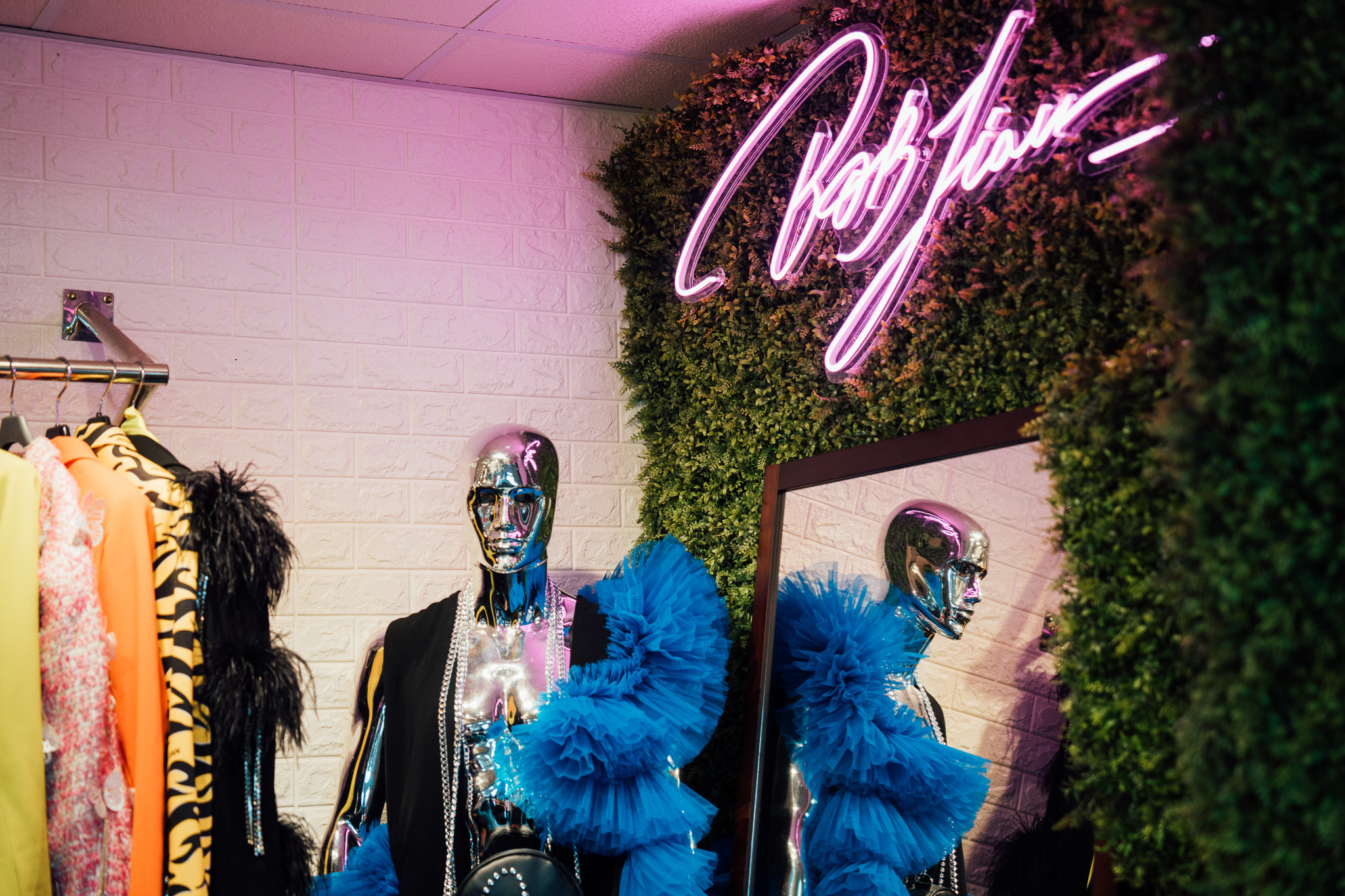
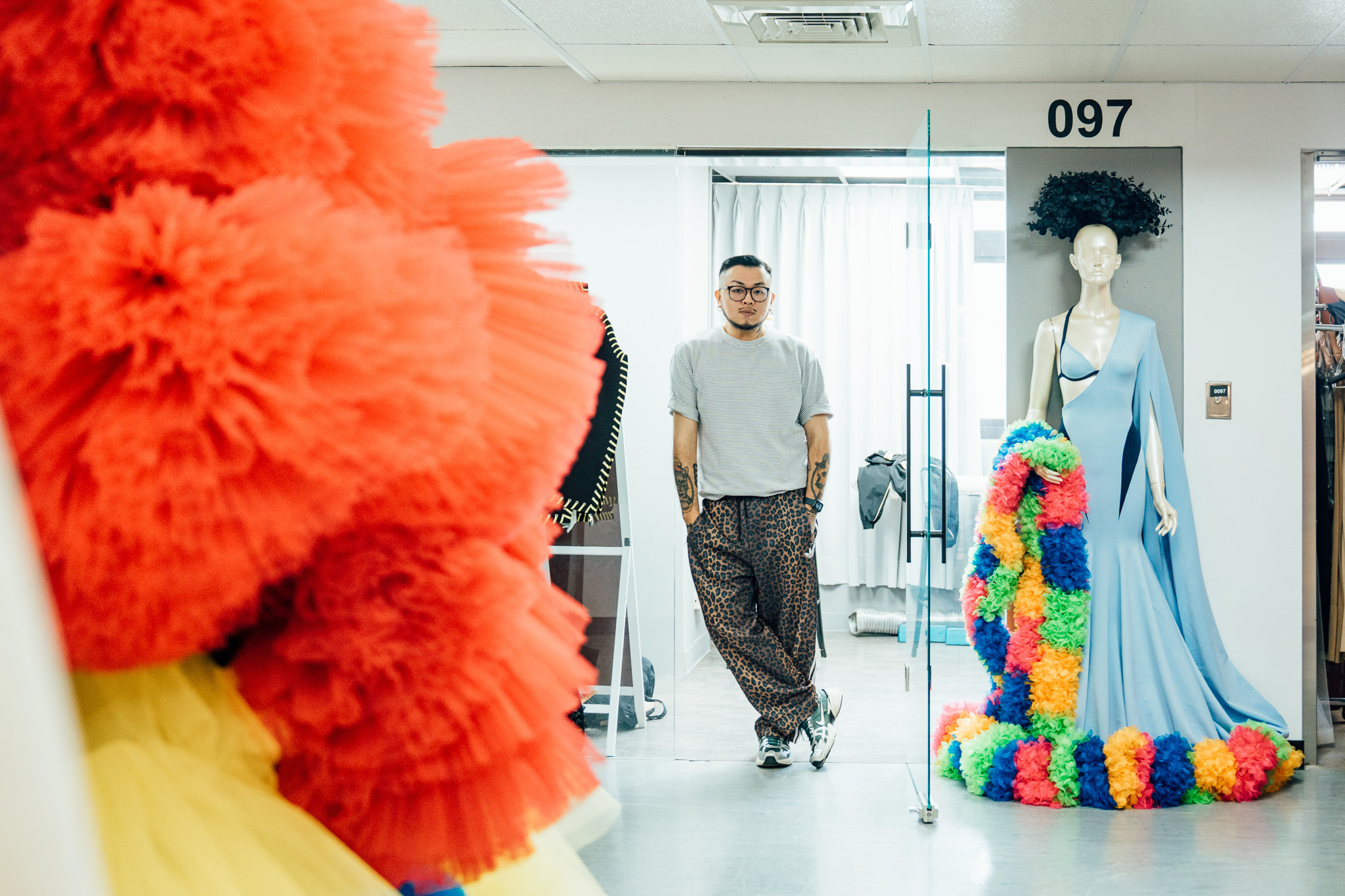
A corner of BOB Jian’s display space inside Yongle Market.
An Accidental Path into Fashion, Establishing an Unconventional Road to Couture
Inside Taipei’s Dadaocheng district, within Yongle Market, a small studio and display space has served for decades as the place where Chien Kuo-Yen has woven his brand dream. Speaking about how he first began studying fashion, he laughs and says that he was originally interested in joining an art program. However, after failing to pass the academic requirements, he was not accepted. His mother had wanted him to attend military school instead.
“To help support the family — very practical,” he recalls. “If I hadn’t studied fashion design, which I thought was related to art, I might now be shouting military slogans somewhere.”
During his time in school, the training often required repetitive movements, almost like working in a ready-to-wear factory. Yet Chien never found it tedious.
“I just liked the feeling of every stitch and every thread. I can’t really explain it.”
From then on, he built a solid foundation in sewing and patternmaking. Later, he encountered total styling, and throughout his subsequent fashion studies, his strong technical basics allowed him to move ahead of the school curriculum. Competitions became a way for Chien to test his own abilities and explore the styles of others.
In particular, after gaining recognition through the 2011 Taiwan Television reality program Super Designer, he continued to win major awards, gradually building momentum for his entrepreneurial path through skill and visibility.

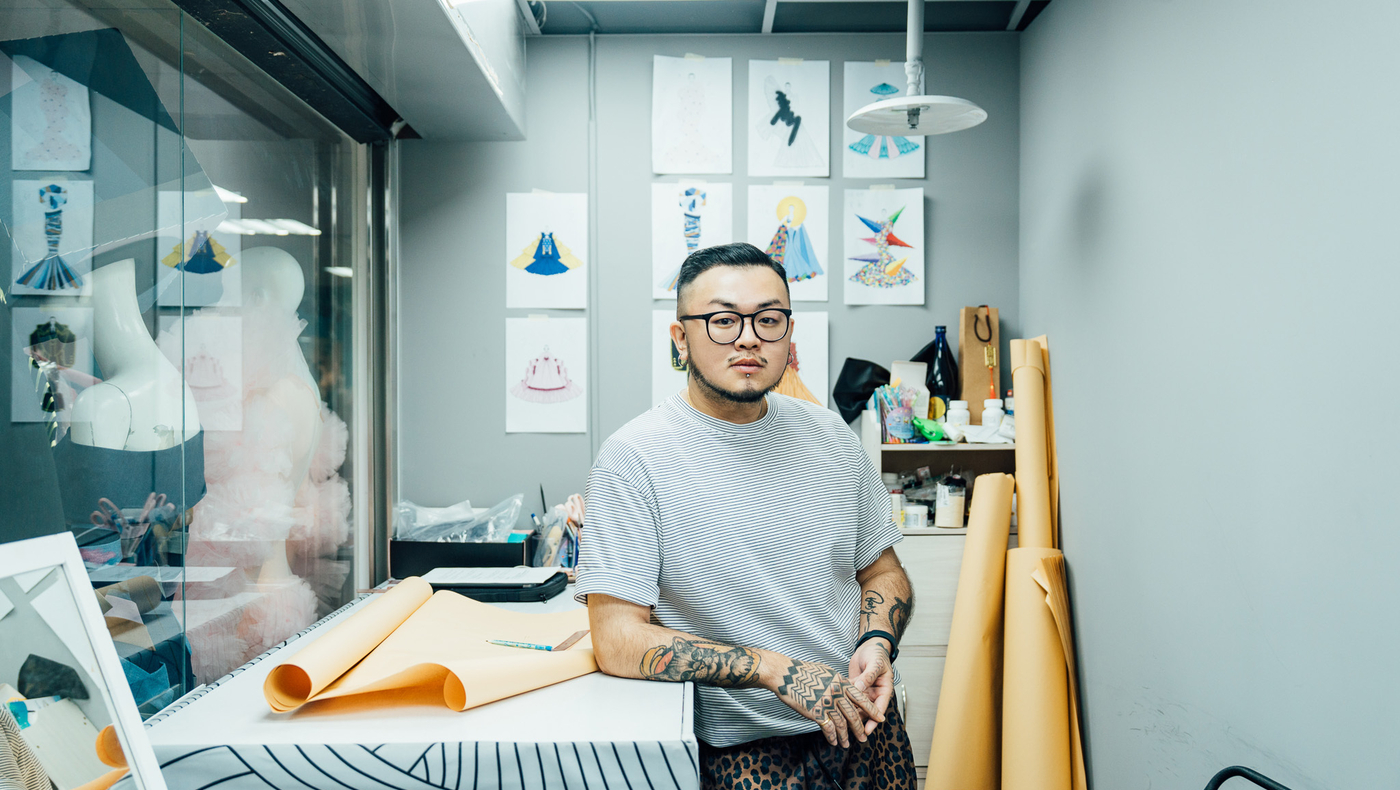
BOB Jian brand designer Chien Kuo-Yen.
In the early days of taking on independent projects, Chien often used leftover fabric from tailoring and patternmaking work for clients to create new pieces. At the time, he was focused purely on realizing creative ideas, often collaborating with stylist, photographer, and model friends to shoot portfolios.
Early in his career, his clothing gained exposure on a Chinese television program after being borrowed by a stylist, drawing considerable attention. It even unexpectedly caught the eye of Shu Qi, who asked someone to contact him to purchase the piece. This became an important turning point in building his reputation and laid the foundation for a path distinct from that of a typical ready-to-wear designer.
“At that time, I had not even been abroad yet, but my clothes had already gone out into the world for me!”
— Designer Chien Kuo-Yen
Chien gradually established a business model in which seasonal collections serve as brand exposure, while custom-made garments and rentals form the operational core. Each season’s creations are not made solely for sales. Instead, they become the strongest showcase of the brand’s style, expanding recognition and return demand through celebrity appearances, red carpet exposure, and the needs of specific clientele.
With exclusive couture as its core, the brand has long created garments for concerts and drama productions. Clients have included Shu Qi, Jolin Tsai, Lin Chi-Ling, Vivian Hsu, Wu Qing-Feng, A-Lin, Chung Hsin-Ling, Eric Chou, and Aaron Yan, among many other stars. In recent years, the brand has also attracted corporate performances, clients seeking special occasion wear, advertising shoots, direct-sales events, and high-end collectors. Because the pieces are not mass-produced and carry a distinctive style, their collectible value is further emphasized.
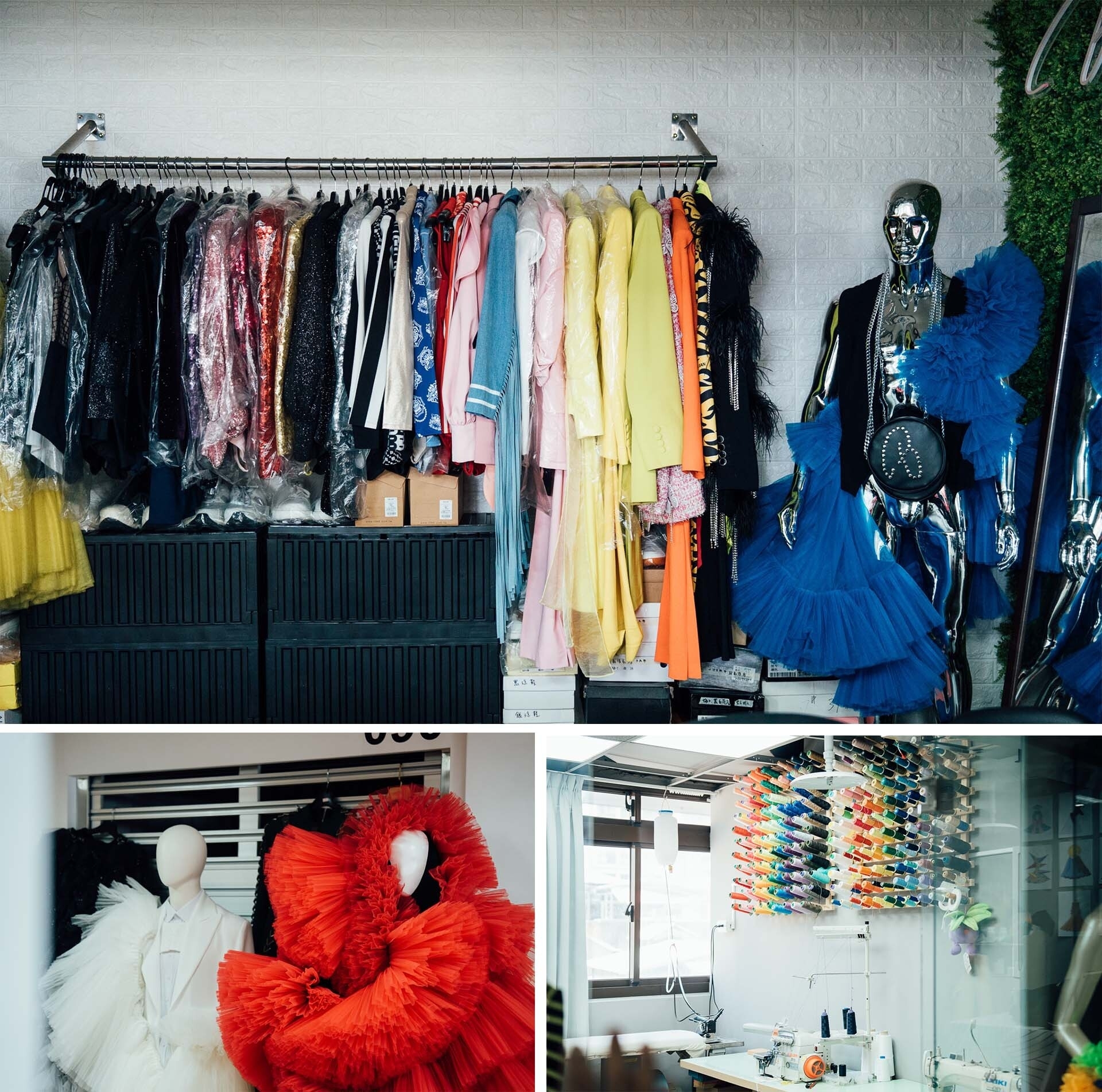
With exclusive couture as its core, BOB Jian is known for bold, eye-catching silhouettes and color palettes, while also giving attention to intricate details. The brand is favored by many artists in Taiwan and abroad. Designer Chien Kuo-Yen notes: “People often say that my runway designs each season are too extravagant for ordinary people to wear. But for artists, I think these designs are already the most basic minimum standard in the entertainment industry.”
Flamboyance Is the Most Precise Description
For Chien Kuo-Yen, the first and most accurate keyword to describe BOB Jian has always been flamboyance.
This flamboyance is by no means merely for effect. Chien’s works seize visual attention through striking silhouettes, then balance that first impact with sharp contrasts and highly refined details. Between expansion and restraint, a beauty of conflict emerges, allowing BOB Jian’s garments to become the first protagonist seen in any styling context.
Though Chien may appear rugged on the outside, another side of his work is composed of delicacy, dreaminess, softness, and elegance. This “gap charm,” as he describes it, gives BOB Jian the aura of an unattainable flower on a high peak: difficult to approach, yet irresistibly captivating.
“Some people say our clothes feel distant,” he says. “And I say: exactly.”
“Everyone has different views of beauty. But whether people criticize me or praise me, they have to see me first. That is why ‘flamboyance’ has always been the first language the brand expresses.”— Designer Chien Kuo-Yen
The uniqueness of BOB Jian also lies in Chien’s ability to take charge of the entire process himself: inspiration, design, patternmaking, cutting, sewing, and more. This allows him to make immediate adjustments to patterns, techniques, and structures at every stage of creation, giving him more direct control over the final completion of each garment.
He believes that Taiwan’s fashion industry has long emphasized “design,” while overlooking the gap in patternmakers and tailors. Coming from a professional tailoring background, he wants people to see that practitioners rooted in technical training can also integrate design ability and rich skills to form a complete creative system.
At the same time, he continues to use funds accumulated through custom-made work to support the development of the brand’s seasonal collections. Through this, he hopes to transmit energy and make the often less visible group of bespoke designers more visible within the industry.
“There are many designers like me who specialize in custom-made garments, but only a few are able to develop enough resources to gain exposure. I hope that at occasions like Taipei Fashion Week, this part of the industry and its voices will not be absent.”— Designer Chien Kuo-Yen
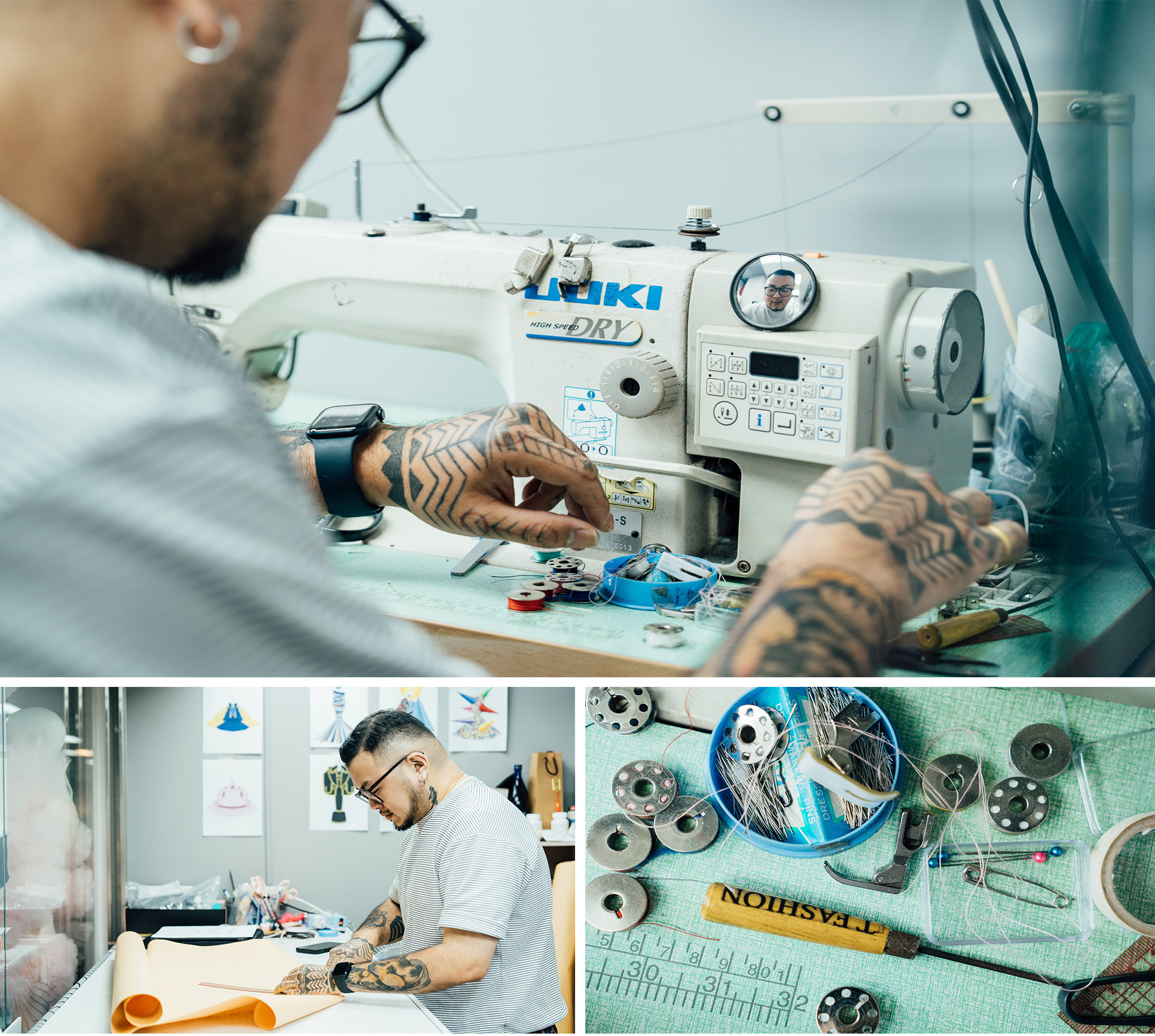
Coming from a professional tailoring background, Chien Kuo-Yen is able, as a designer, to handle patternmaking, cutting, sewing, and other processes on his own. This is why he possesses such precise control over his garments. He also believes that thinking rooted in technical foundations can inspire meaningful two-way exchange with designers trained primarily in design.
This developmental trajectory is also reflected in the evolution of Chien’s creative methods. In the past, he often began intuitively from the characteristics of fabrics and the possibilities of styling, with concepts added and packaged afterward. But as he has grown older and accumulated more life experience, he has become increasingly able to transform personal feelings, life memories, and inner states into a garment language.
From creative stimulation gained through travel, to his collaboration with Zhenshou Temple Wu Jingtang Arts Troupe for Taipei Fashion Week AW23 under the theme Salute to Tradition: Crossovers Between Traditional Performing Arts, Traditional Crafts, and Fashion, where his love of the Eight Generals culture was transformed into a new-generation interpretation, Chien’s works are no longer merely beautiful garments. They are closer to creative practices of self-revelation.
“Whether it is custom-made work that follows the client’s will, or design in which I can freely express creativity and personal perspectives, it seems that I can now face myself more honestly, like an artist.”— Designer Chien Kuo-Yen
Continuous dialogue, continuous questioning, the courage to look directly into the heart, and an even greater courage to gaze at the self — Chien likes this transformation and growth, and finds surprise in it.
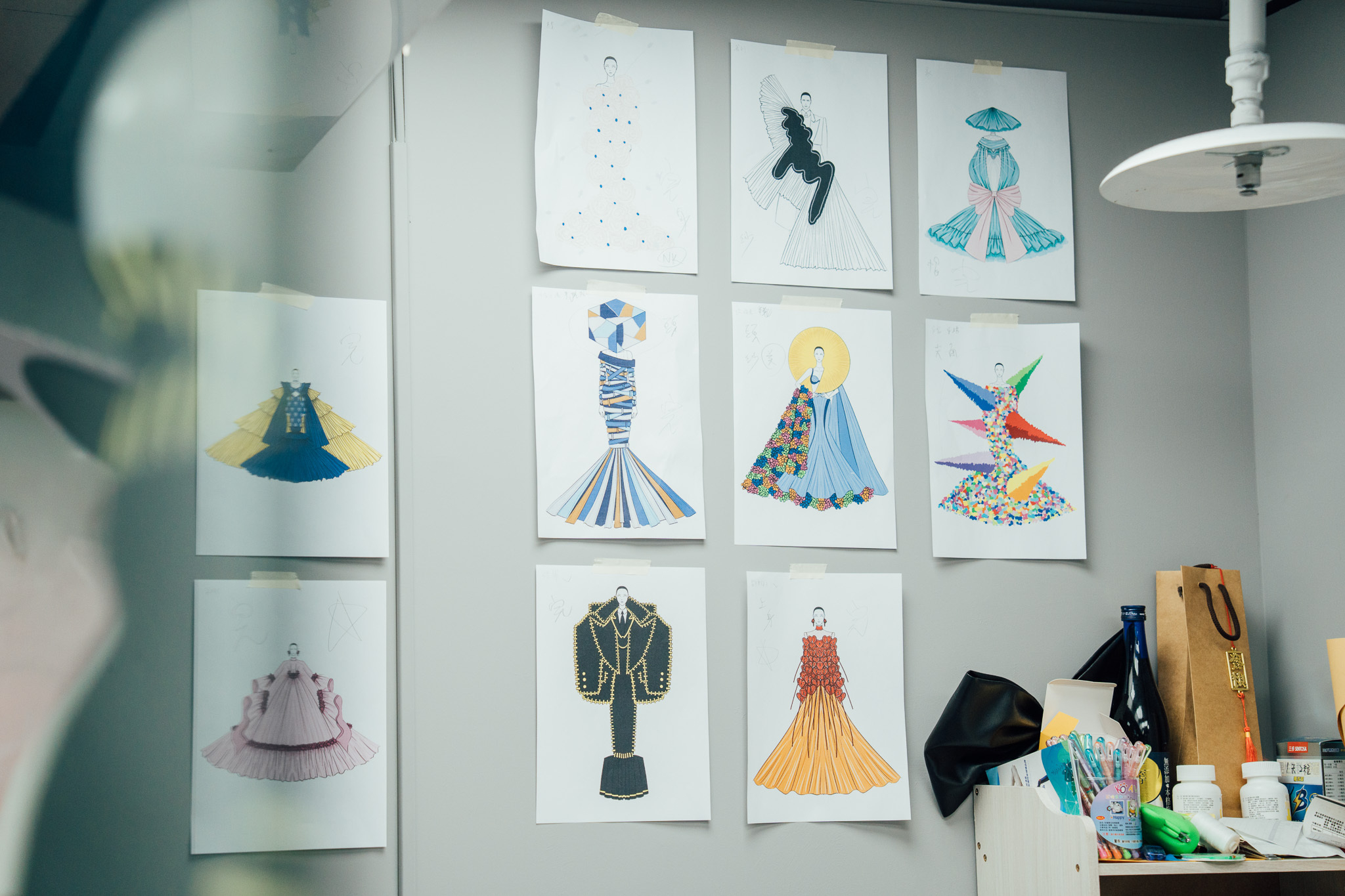
Through the accumulation of time and life experience, Chien Kuo-Yen’s creative inspiration has gradually shifted from a starting point grounded in technique toward a practice that excavates the inner self. The What Remains series, presented at Taipei Fashion Week AW26, begins from intimate life experience, turning his creative perspective from an outwardly glamorous stage toward inward personal perception and dialogue with existence.
Dissecting the Inner Self and Reconstructing the Self: Using Clothing to Leave a Confession for Heartbreaking Loss
This year, for Taipei Fashion Week AW26, BOB Jian presented the exhibition What Remains, gathering the essence of the brand’s work over the years. Held from March 27 to March 29 at the Men’s Bathhouse of the West Tobacco Factory in Songshan Cultural and Creative Park, the three-day exhibition was also the first ticketed presentation in Taipei Fashion Week’s history.
It was not merely a presentation of new work, but Chien Kuo-Yen’s first time using the form of a fashion art exhibition to transform the loss of his mother, family memories, and self-reconstruction into ten works. From the flamboyant aesthetic familiar to audiences, the exhibition moved toward a more naked exploration of the inner self.
The series originated from the most difficult period of Chien’s life. Last year, in 2025, he experienced the sudden passing of his mother. At the same time, both work and his personal relationships approached a breaking point. Having always immersed himself in work, he was forced for the first time to stop and confront his own vulnerability.
During the funeral period, the phrase “leaving suffering and attaining joy”, repeatedly heard amid comfort and chanting, became the starting point for the theme What Remains. He wove longing into garments and gave grief a place to rest. This presentation does not speak only of death, but of how love and relationships continue after loss.
“What Remains is not an outlet for emotion, nor does it take transformation or healing as its purpose. Rather, without harming what has been lost or transferring that weight onto the viewer, it arranges a path forward for those who remain.”— Designer Chien Kuo-Yen
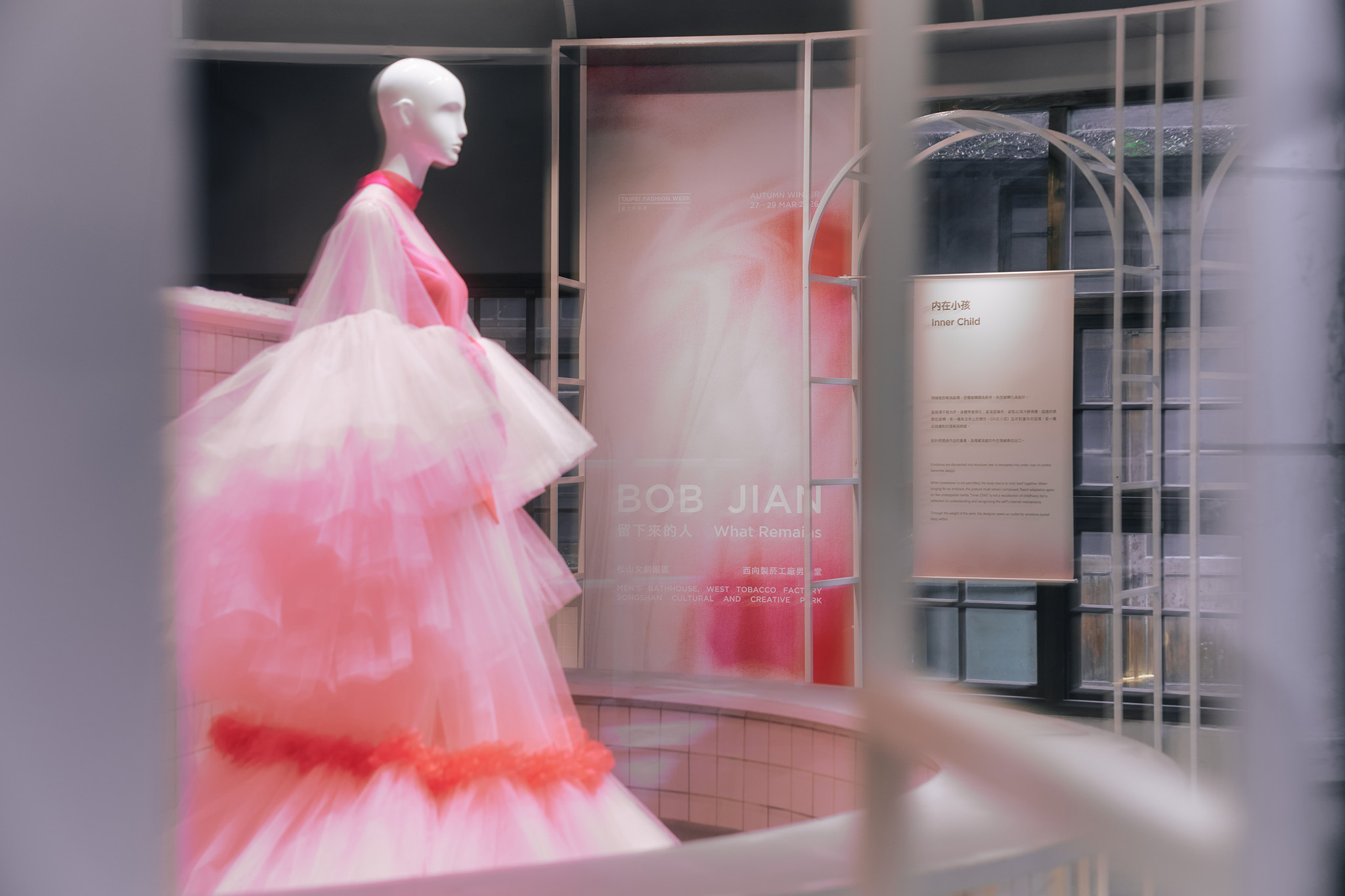 BOB Jian’s What Remains was presented in the form of a presentation at the Songshan Men’s Bathhouse, showcasing ten refined works distilled by designer Chien Kuo-Yen after the pain of losing his mother and enduring a low point in life. The work pictured is Placement. Photography by Shawn Sun @shawnsun.photography.
If clothing is now the language Chien knows best, then “A-Sen” — the name by which he calls his mother — was the place where he first learned language. Just like having his mother’s name tattooed on his body, this exhibition connects deeply to Chien’s bonds with her and with his family.
The garment factory where A-Sen worked was part of Chien’s childhood memories, and even subtly led him toward a profession connected to her.
“My first tool for making a living was something my mother left behind,” he recalls. “I earned some money using my mother’s sewing machine — and eventually used it until it broke.”
From a mother who could not understand why her son was always so busy, to the daily intimacy of mother and son working late into the night together, bickering like best friends while relying on one another, these memories form the most moving background to the exhibition.
What Remains was ultimately presented as a presentation, which came closer to Chien’s desire to create an “art exhibition” rather than a simple fashion show. He notes that the choice of the Songshan Men’s Bathhouse as the exhibition venue was meaningful. In the past, it was a place where bodies were cleansed; now, it symbolizes a space where emotional purification can take place.
The garments are like individual fragments of emotion placed within the exhibition space, entrusted to the gaze of the public.
“A static display allows viewers to see the details more clearly. But the works must be able to withstand long periods of attention, even magnified viewing. Especially within such a short production period, it was actually very torturous for me,” Chien says.
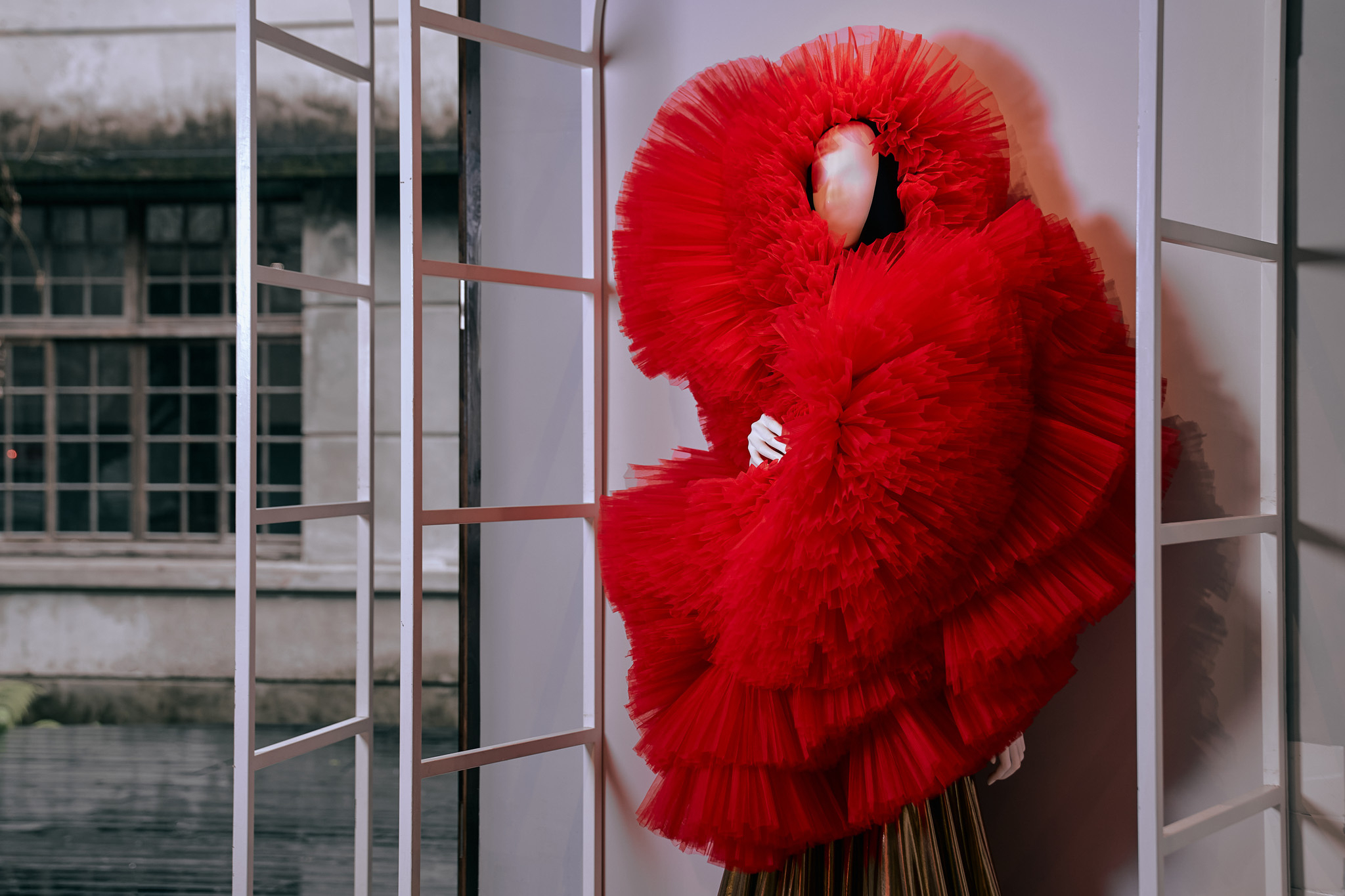
Chien Kuo-Yen believes that compared with a fast-paced runway show, a static presentation allows viewers to appreciate the works up close at their own pace. The work pictured is What Is Left? Photo courtesy of Taiwan Design Research Institute — Taipei Fashion Week; photography by Shawn Sun @shawnsun.photography.
Looking back on the creative process, due to venue scheduling and design adjustments required by the environment, Chien had only 20 days for production. During this time, he was almost always working while also enduring repeated emotional surges and direct confrontations with himself.
“When my assistant saw me with a towel around my neck, they knew not to come near me. That meant I was crying.”
“I probably spent more than half the time crying. Sometimes you can escape, or choose not to deal with it. But I chose to face my wound. Constantly touching it may have made it hurt more, but I could not forget it.”— Designer Chien Kuo-Yen
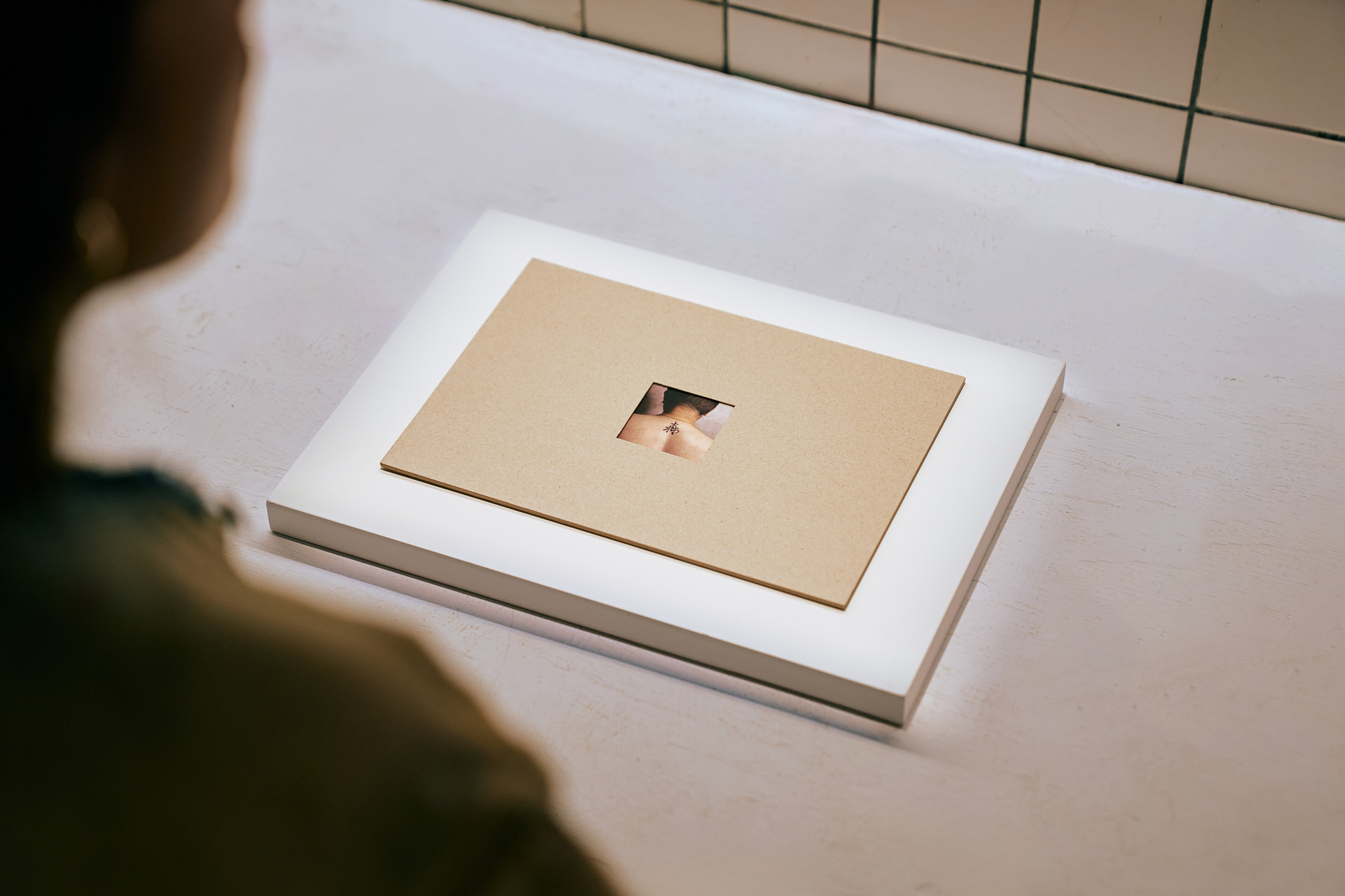
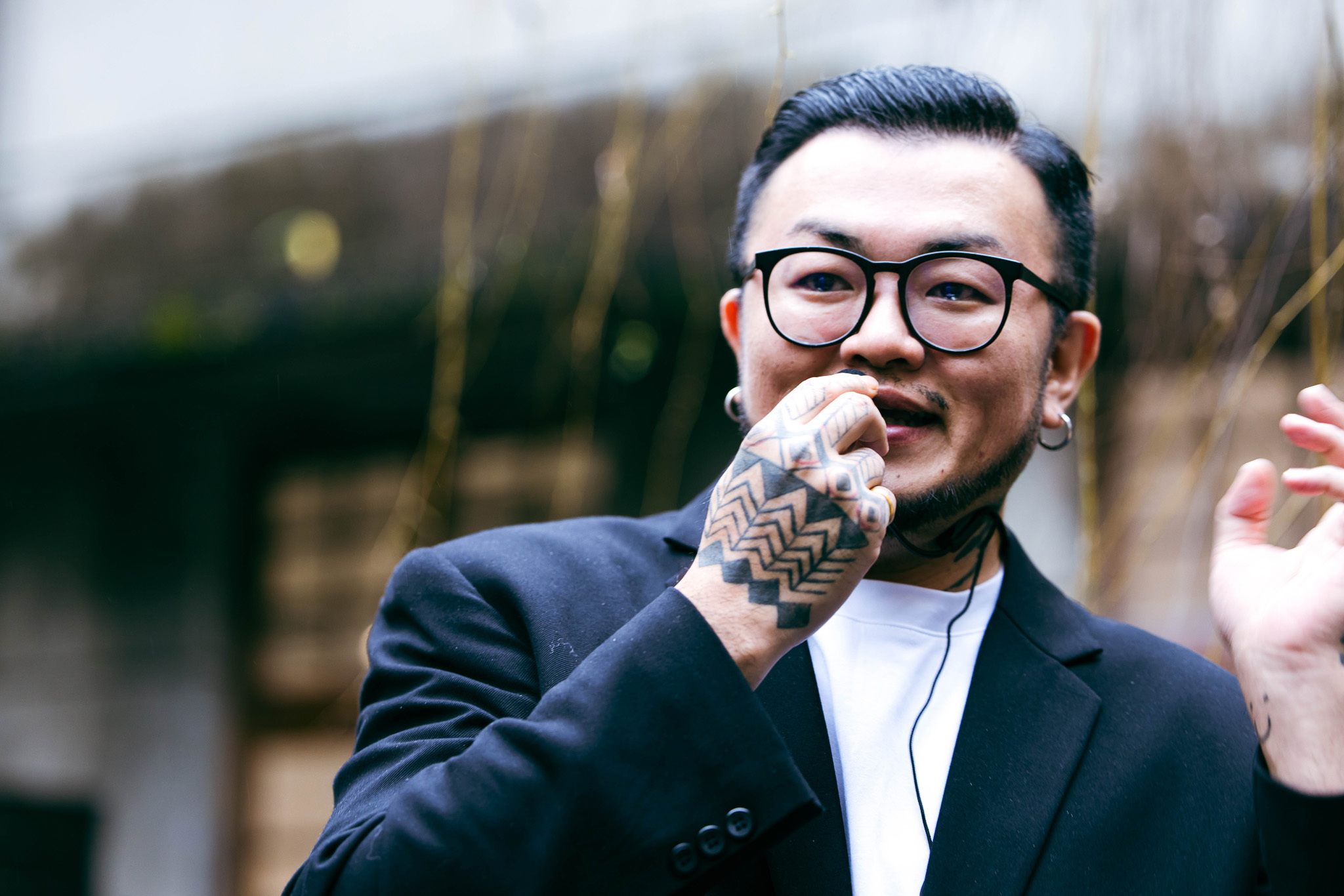 Just as his mother A-Sen’s name is tattooed onto his body, on the opening day of the exhibition, Chien Kuo-Yen, slightly tipsy, temporarily set aside his restraint and allowed deeply held emotions to surface and breathe. During the guided tour, this designer known for his witty speech could not stop the tears welling in his eyes, and the audience followed his emotions, with laughter and sobs intertwining throughout the space. Photos courtesy of Taiwan Design Research Institute — Taipei Fashion Week; photography: upper image by Shawn Sun @shawnsun.photography; lower image by Irene Lin.
Chien hid this emotion in his sketches, in garment silhouettes, fabrics, and the exhibition route, allowing viewers to slowly enter and feel their way through it. The ten works make extensive use of tulle and fishtail skirt elements. The seemingly light and transparent tulle in fact carries an unimaginable weight. The fishtail skirt structure conveys the sense of support he felt during moments of collapse.
Through clothing, the exhibition extends into a process of loss, carrying, splitting, repair, and becoming whole again.
Against the Wind writes of his mother’s persistence in moving forward through wind and rain. Placement wraps farewell in heavy yet translucent layers. Glazed Light borrows the image of Buddhist light to send the departed away from suffering. What Is Left? begins from an inherited ring, questioning the weight borne by those who receive what remains. Home presents the dual nature of family as both support and restraint. Inner Child transforms childhood trauma into a bound structure of survival. Split releases mixed emotions through the muddiness of layered vivid colors and spiked forms. Repair uses three layers of different degrees of completion to describe the process of self-reconstruction.
Finally, through Whole and Sign-In, the exhibition moves toward an open state. Wholeness does not mean being without cracks, but being able to extend outward while carrying one’s traces. Viewers are invited to leave their signatures, joining in an act of companionship and witnessing.
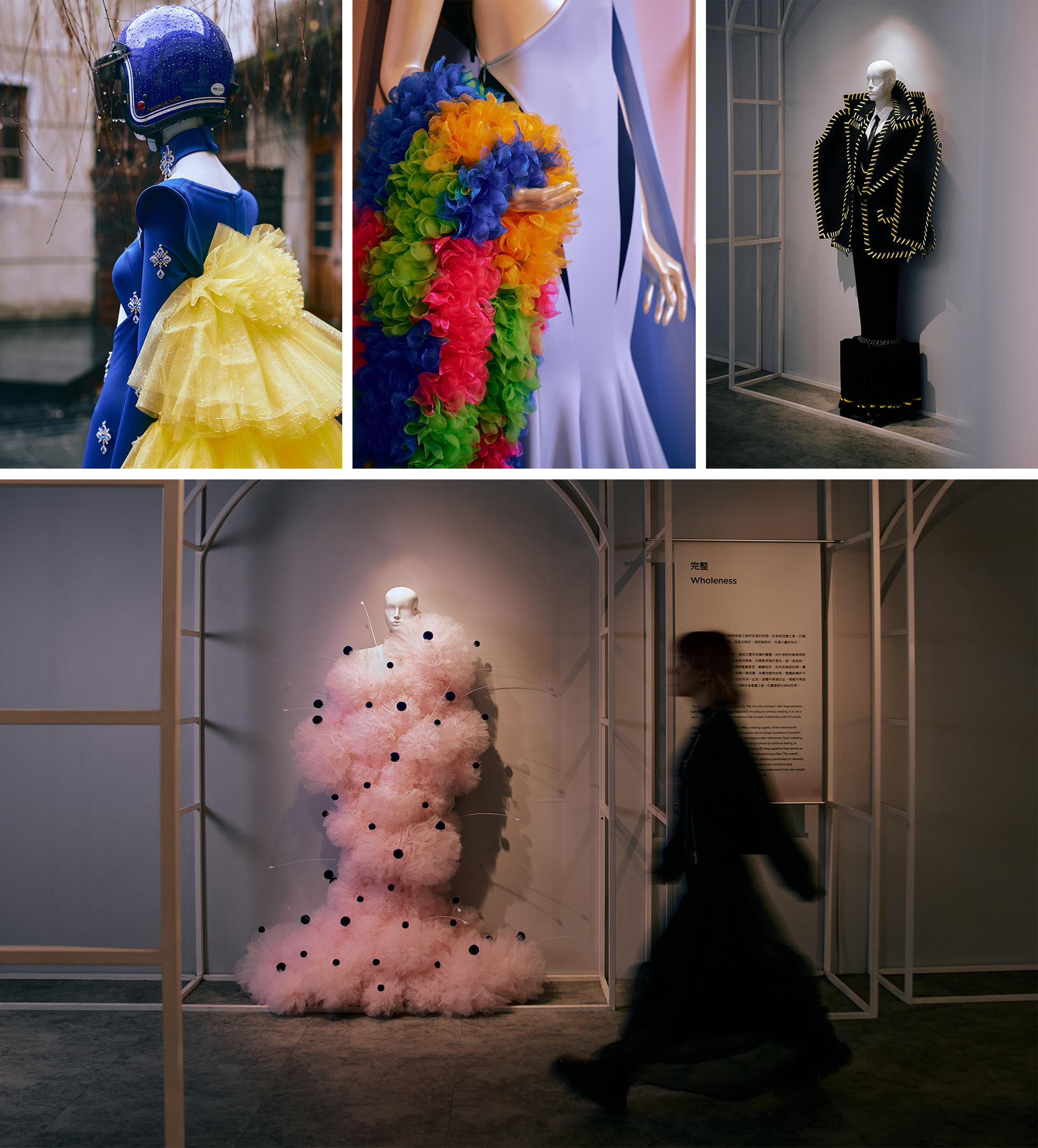
What Remains inversely points to the experience of loss. Through the departure of an intimate family member, BOB Jian explores how personal will is reshaped and how the self is redefined in the face of dramatic change. Beginning with Against the Wind outside the venue, shown in the upper left, the exhibition unfolds this process through ten works. Upper center to right: Glazed Light and Repair; lower row: Whole. Photos courtesy of Taiwan Design Research Institute — Taipei Fashion Week; photography: upper images by Shawn Sun @shawnsun.photography.
What moved Chien most after the exhibition was the feedback he received. Some viewers thought of their own loved ones in front of the works. Some were reminded by the handwritten sketches of words they had never spoken. Others looked back at unresolved wounds in their own lives.
Clothing became a vessel for placing emotion and memory.
“I believe these ten works will, more or less, evoke different angles of thought in each person’s life experience.”
— Designer Chien Kuo-Yen
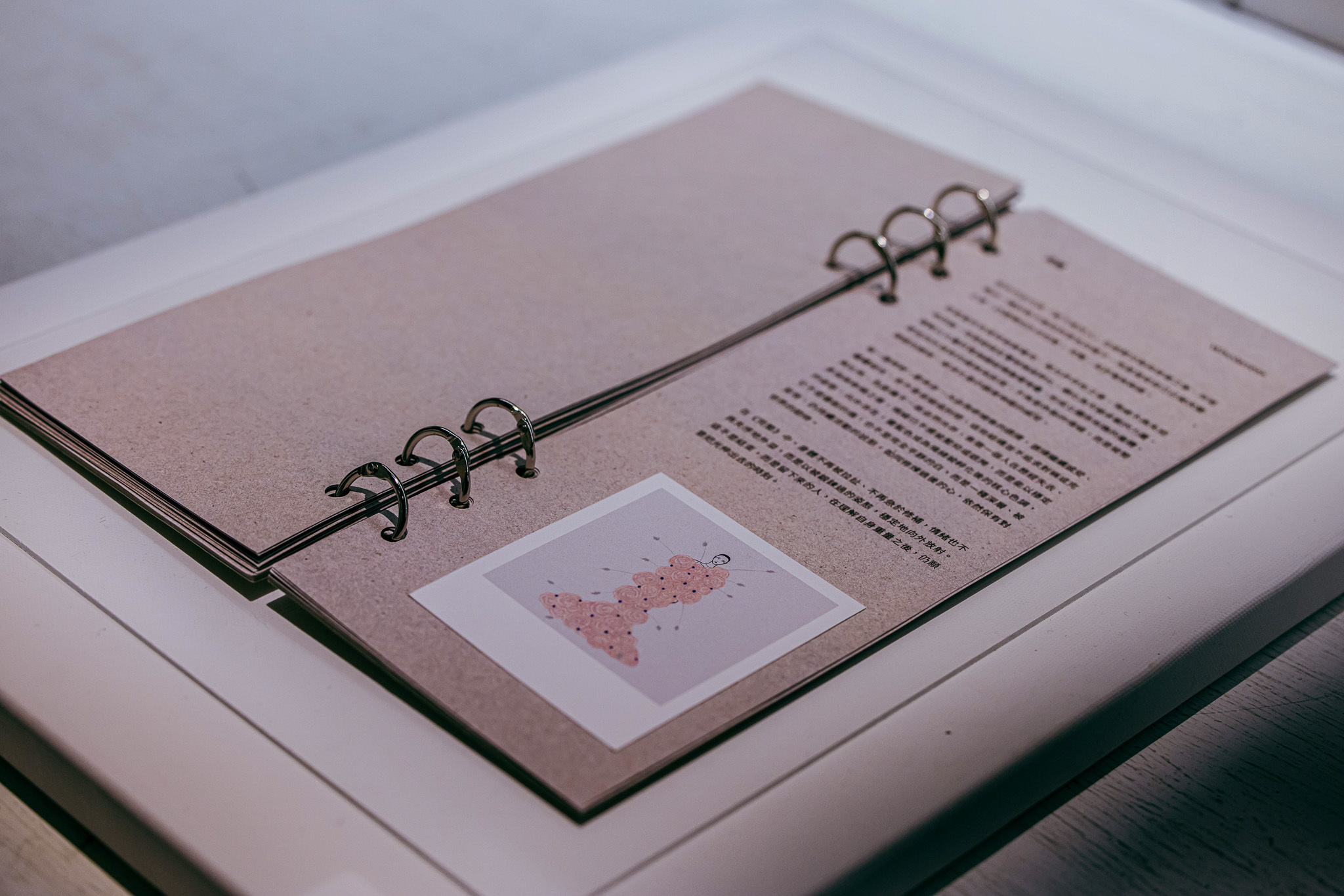
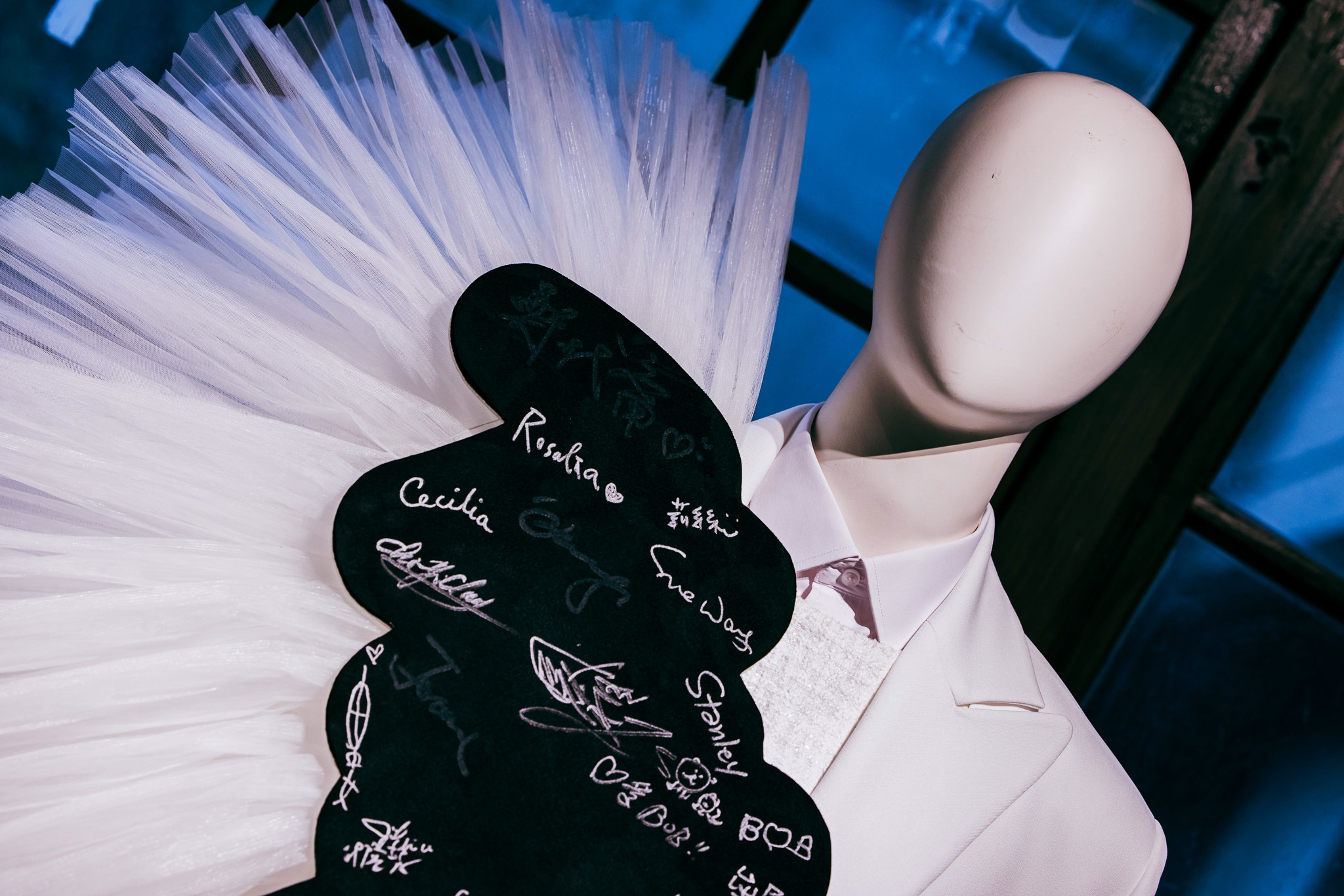 Chien Kuo-Yen revealed that many viewers broke down in tears because of the raw self-portraiture and written records in the sketches. The exhibition also arranged the final work, Sign-In, allowing viewers to become part of the work’s “re-completion,” like witnesses to wholeness regained, continuing forward with the designer. Photos courtesy of Taiwan Design Research Institute — Taipei Fashion Week; photography by Irene Lin.
Those Who Remain Eventually Find a Road Forward
In the past, Chien Kuo-Yen excelled at creating dazzling forms for others to be seen by the world. This time, he placed himself inside the works, opening hidden wounds and allowing audiences to see the soft, vulnerable person behind the flamboyance.
This presentation was also a complete interpretation of how Chien transforms emotion in his own way. Often invited to serve as a jury member for student exhibitions and competitions, he shares that he hopes creators, when presenting wounds or issues, can absorb and transform them rather than simply show them directly.
“I don’t think we need to express negativity by adding more negativity,” he says. “Allowing existing labels to take on different definitions and appearances through the work seems to be what designers should do.”
What Remains is not only an elevation of BOB Jian’s seasonal work, but also resembles a designer’s renewed illumination of his own state during the lowest point of his life. What has been lost cannot be erased, and grief has not ceased because of this exhibition. Chien says that even after completing everything, his emotions are still not fully settled. But this was a journey of courageous confrontation.
“Then maybe I will travel again, or go do things I did not dare to do or had never done before.”
A person can find a way to stand and move forward through pain. This time, he is certain that he can slowly continue walking onward.
▐ Interview & Writing / Irene Lin
▐ Editor & Coordinator / Irene Lin
▐ Interview Photography / Seeyu Chen
About the Brand|BOB Jian
BOB Jian began working in bespoke garment-making in 2011 and officially established the BOB Jian custom brand in 2018. The brand has collaborated with more than one hundred artists. With exclusive couture as its core, it has long provided garments for award ceremonies, concerts, drama productions, and other performance contexts. Through artist exposure, the brand has expanded its market, while also using rental services to meet consumers’ needs for special occasions, balancing style with a philosophy of avoiding waste.
About the Designer|Chien Kuo-Yen
BOB Jian designer Chien Kuo-Yen first gained recognition in 2011 through the reality program Super Designer. In 2016, he won the Best Patternmaking Award at the Taipei TOP Fashion Design Award, and in 2017, he won the Gold Award. In 2025, he received the Fashion New Creative Design Award from TAFAD. He has long created concert looks and red carpet gowns for numerous well-known artists, becoming a representative fashion designer in Taiwan’s entertainment industry.
▐ Brand Website: https://www.instagram.com/bobjian/
▐ Contact: mumumu772@hotmail.com