
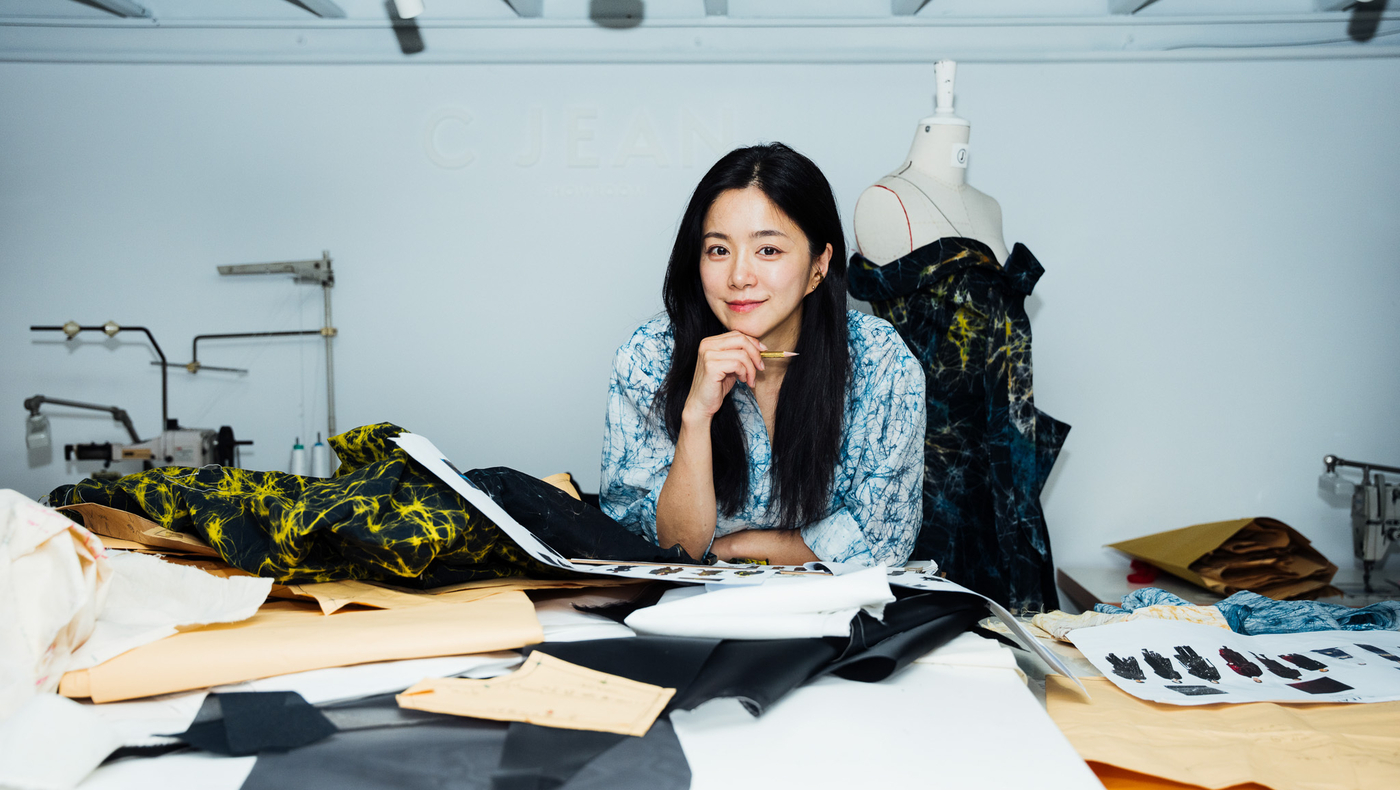
Time never disappears; it merely changes form. Although fashion trends often propel certain aesthetic elements into the public eye, the styles and craft traditions that have existed throughout history do not simply vanish with the passing of trends. Instead, they remain like a shared treasury of human wisdom, waiting to be transformed and reinterpreted by a new generation of designers.
For C JEAN founder, designer, and interdisciplinary creator JEAN, Chun-Yuan, clothing has never been merely the construction of a look, but a way of questioning time, culture, and states of being. Moving fluidly across fashion design, fiber art, and curatorial practice, she continues to approach clothing with the rigorous logic of a designer and the reflective perspective of an artist, using garments as a method of inquiry to explore how traces of the handmade can leave evidence of time passing across material surfaces.
Among all artistic mediums, fabric is perhaps the one closest to the skin. It wraps the body and memory, carrying outward forms while also holding emotions that are difficult to articulate. For JEAN, creation is not about chasing trends, but about recognizing things older and more enduring than trends themselves. This belief found its most penetrating material expression when she encountered SHOBIEN, a Kyoto workshop dedicated to preserving the thousand-year-old craft of rōketsu dyeing. At Taipei Fashion Week AW26, this encounter was developed into a more complete creative statement through the cross-disciplinary art collection SA TA NA MA, realized through the collaboration between C JEAN and SHOBIEN.
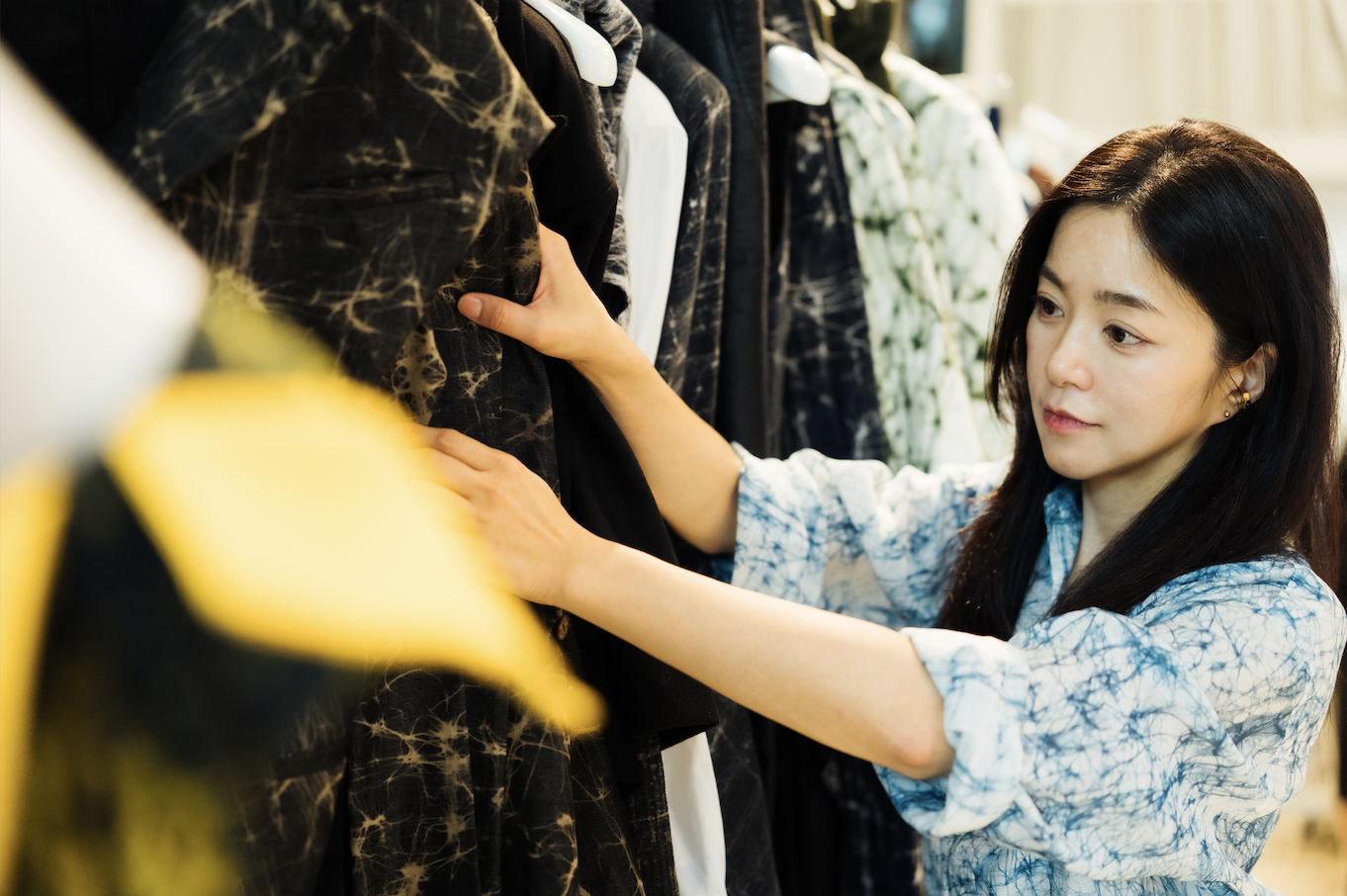
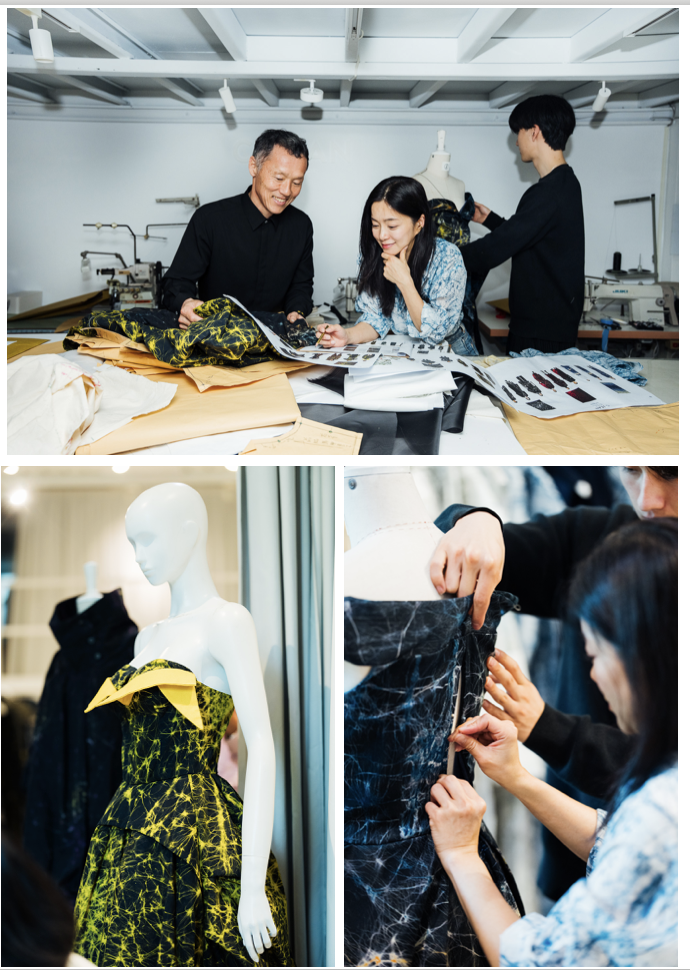
C JEAN brand designer JEAN, Chun-Yuan. In her studio, she examines the fabrics and garment details of the collection, continuously searching for the forms that best carry the spirit of the work through materials, patterns, and wearable structures.
A Millennia-Old Luxury That Endures Through Time
Rōketsu-zome, a wax-resist dyeing technique that has continued in Kyoto for more than 1,200 years, is a traditional craft that uses wax as its brush and time as its pigment. As wax flows across the fabric and cracks spread through the dye bath, each trace is not the result of precise calculation, but a mark jointly left by time, material, and manual labor. Within this process, the artisan does not simply control the outcome, but seems to listen, through repeated waiting and observation, to how the material speaks for itself.
This led JEAN, Chun-Yuan to realize that rōketsu-zome is not merely a dyeing method, but a philosophy of imperfection. The patterns formed through cracked wax emerge precisely from what human hands cannot fully control. It is in this very place that the work gains its most irreproducible quality. For this reason, she decided to collaborate with SHOBIEN, currently the only workshop in Kyoto still carrying on this craft, allowing this ancient technique not only to be preserved, but also to be seen, understood, and given new life within the context of contemporary design.
“To me, true luxury is closer to a beauty that has been distilled through time.”
— Designer JEAN, Chun-Yuan
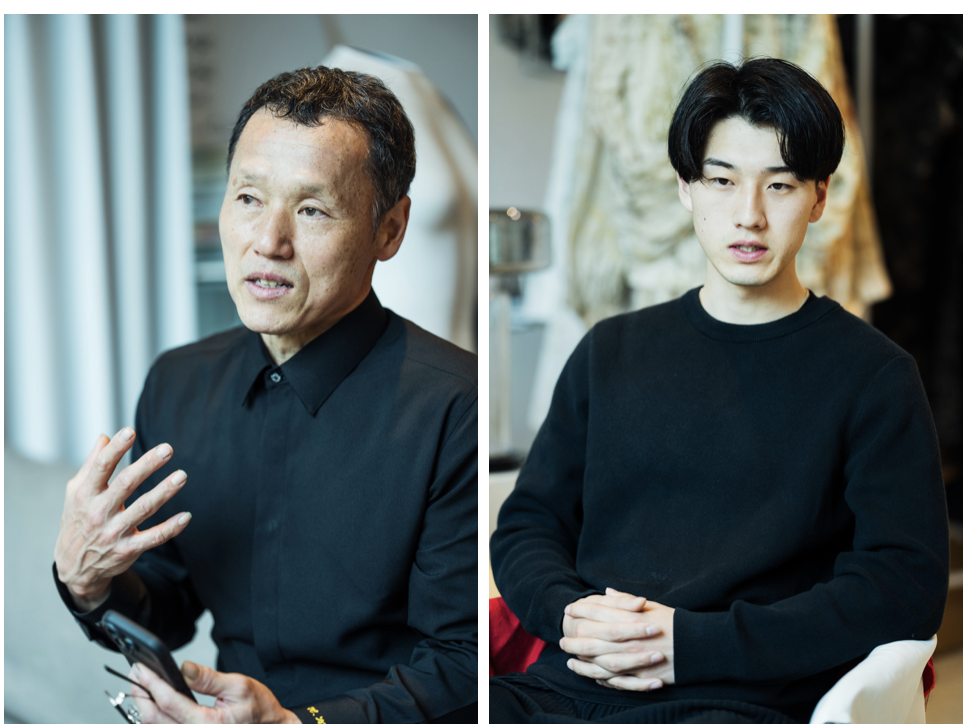
For its 26AW collection, C JEAN collaborated with SHOBIEN, a Kyoto rōketsu dyeing workshop with more than six decades of history, translating traditional craftsmanship into a contemporary design language. Left: second-generation rōketsu dyeing artisan and CEO Hiroyuki Kambayashi; right: third-generation Ousuke Kambayashi.
Founded in 1963, SHOBIEN has now continued for more than 60 years. Second-generation rōketsu dyeing artisan and CEO Hiroyuki Kambayashi began learning the technique from his father at a young age, and has personally witnessed the survival and disappearance of this craft amid changing times. According to his recollection, around 60 years ago, there were originally five workshops in Kyoto specializing in traditional dyeing. However, as industrial structures shifted and efficiency-driven production methods emerged, most dyeing workshops gradually withdrew from the field. Only SHOBIEN has continued to operate.
When speaking about how the workshop has endured until today, Kambayashi notes that beyond its unwavering commitment to handcraft, an even more crucial factor was its willingness to adapt during periods of change. When traditional fabric widths could no longer respond to market needs, SHOBIEN chose to introduce equipment capable of dyeing wider textiles, allowing rōketsu-zome to enter more contemporary applications. This attitude of refusing to abandon the essence of the craft while remaining willing to respond to real-world conditions has allowed SHOBIEN to survive within a rapidly changing industry.
This is precisely why JEAN, Chun-Yuan places such importance on this collaboration. For C JEAN, what deserves to be brought into the contemporary moment is not tradition frozen as a historical specimen, but craftsmanship that can continue to grow and respond to the present. What makes SHOBIEN so moving is not simply its rarity, but the fact that it proves tradition can move through time not because it remains in the past, but because it continues to possess the ability to form new relationships with the present.
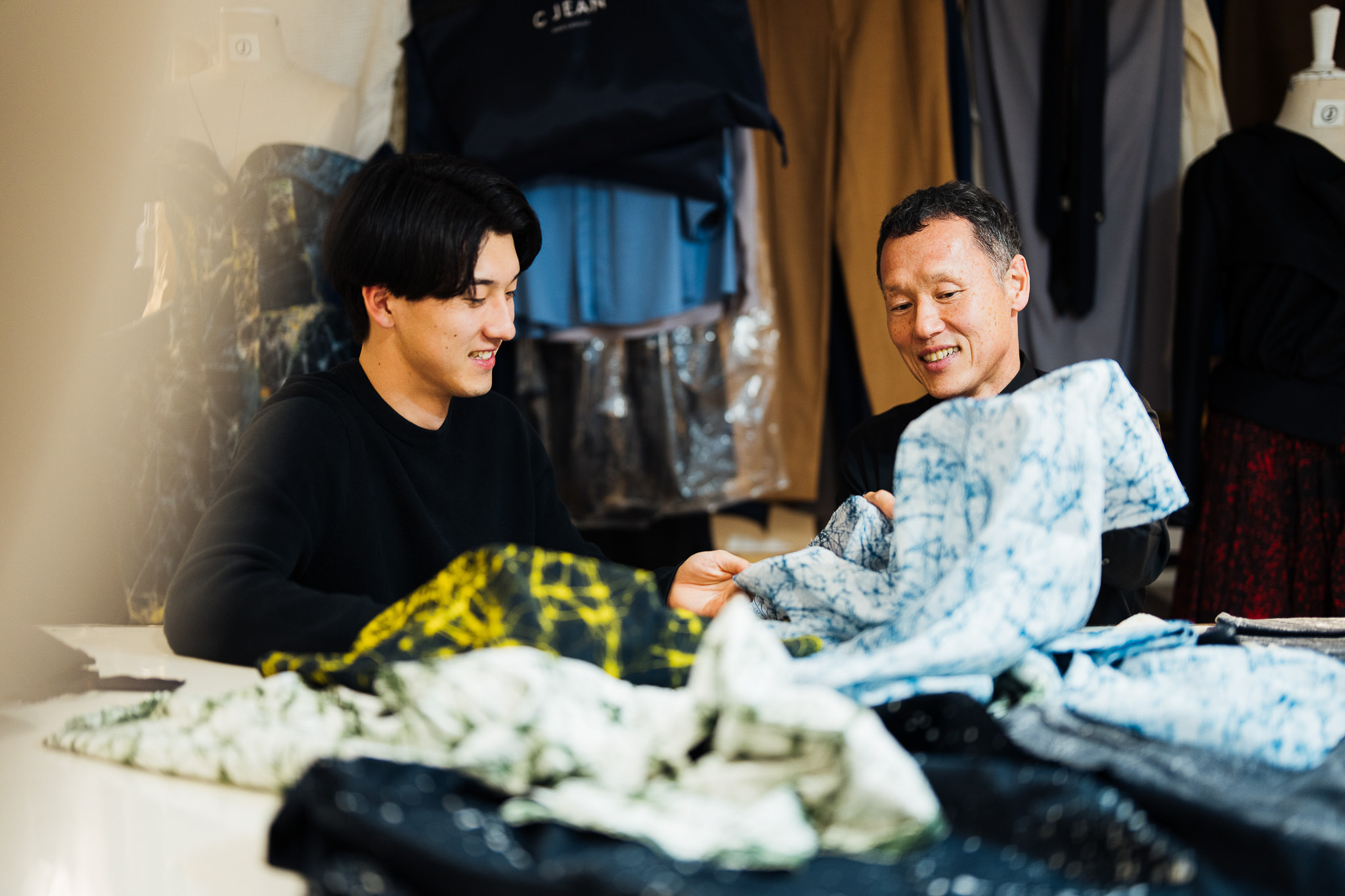
Since its founding in 1963, SHOBIEN has continued into its third generation. The key to its endurance lies in its willingness to adapt during changing times without losing the essence of its craft.
Two Ancient Answers Meet in Silicon Valley
Interestingly, the origin of the collaboration took place somewhere seemingly unrelated to traditional craftsmanship: Silicon Valley. JEAN, Chun-Yuan had traveled there to participate in an entrepreneurship program. In an environment where nearly everyone was moving toward technology, AI, and efficiency-driven solutions, she met Ousuke Kambayashi, the third-generation successor of SHOBIEN, who had likewise arrived from the world of tradition. On the surface, it may have seemed like a coincidence. Yet, viewed through a deeper historical context, it felt more like two ancient answers being placed in the most future-oriented environment, where they could recognize one another anew.
In a field defined by speed, replication, and visions of the future, the questions the two of them cared about appeared even more fundamental: in an age where machines can reproduce almost everything, what is the meaning of handcraft? After several in-depth conversations, they gradually realized that perhaps the question itself was the answer. In Silicon Valley, a place that speaks in the language of the future, C JEAN’s design and SHOBIEN’s craft became the clearest mirrors for one another. It was as if fate did not need to declare itself deliberately, but simply allowed the two to see, in the most unexpected place, that they were both searching for the same things: time, handwork, and values that cannot be replicated.
“Through our conversations, we gradually came to understand that at a moment when technology is flourishing, people’s need for physical touch and uniqueness will also become increasingly strong.” — Designer JEAN, Chun-Yuan
C JEAN and SHOBIEN began this profound and moving collaboration through a shared recognition and pursuit of the same values.
Rebirth Beyond the Surface of Life and Death
After the collaboration was confirmed, JEAN, Chun-Yuan began traveling frequently to Kyoto, conducting multiple rounds of dyeing tests and fabric development with SHOBIEN. Although SHOBIEN had previously provided custom textiles for various international fashion brands, its role had mostly been one of craft support or material supply. This collaboration with C JEAN, however, was no longer a one-way commission to produce fabric for a brand. Instead, it became a shared process that moved from material testing and pattern generation to garment structure and the construction of an overall creative worldview. In this way, the craft truly entered the heart of the creation and became part of the spirit of the collection.
For SHOBIEN, which began with the dyeing of noren curtains, garment textiles were not originally its main line of work. In addition, contemporary fashion fabrics are already very different from traditional cotton and linen materials. Every newly used fabric had to undergo repeated testing. If the color development, crackle effects, or texture failed to achieve the desired result, C JEAN, as the design side, also had to readjust its fabric choices and garment direction. This made the collaboration not a one-off technical commission, but a process through which design and craft calibrated and opened up one another.
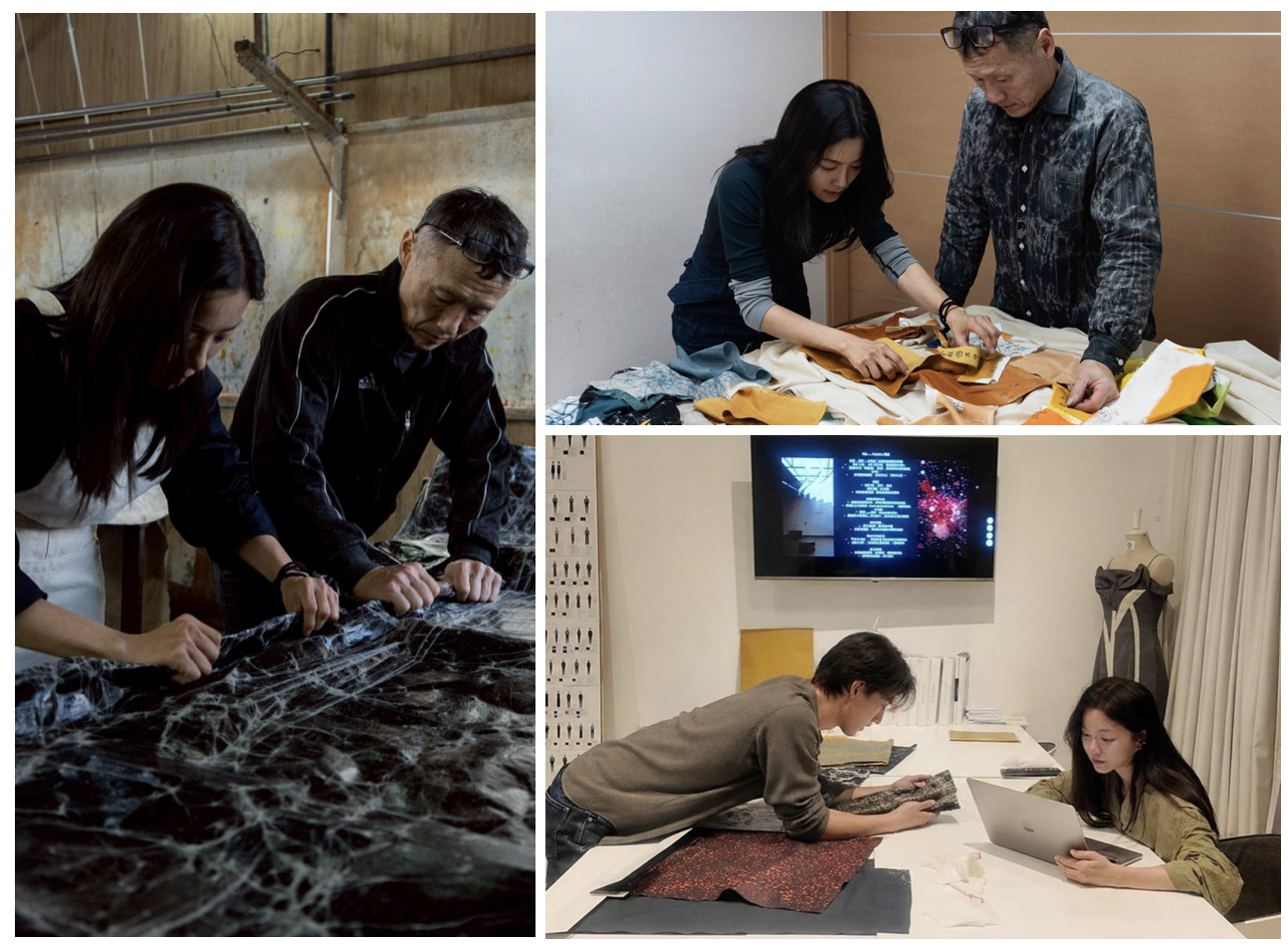
For this collaboration, C JEAN and SHOBIEN began a year-long process of repeated discussion and testing, ultimately condensing cracks, particles, light, and shadow onto the fabric surface, transforming textiles into a medium that carries time and memories of existence. Photo courtesy of Shota Inoue @_shotainoue.
Although the collaboration with SHOBIEN had already begun, what truly pushed the collection into deeper territory wasJEAN, Chun-Yuan’s experience of losing a close family member. During that period, when time seemed to have been paused, she accompanied a life toward farewell while also beginning a process of physical and emotional healing through profound grief. Yet this experience did not interrupt her creation. Instead, it led her to understand time, existence, and disappearance anew, and prompted her to ask: is death truly an ending, or is it merely life returning in another form?
During this period, she encountered yoga and Brazilian jiu-jitsu, exploring the self again through the multiple layers of body, consciousness, and spirit. Gradually, she built a more stable and resilient inner state. This practice was not only a period of recovery; it later became an important way for her to repair both body and mind, and formed a process through which she came to understand the structure of life anew. From this emerged the 26AW collection titled SA TA NA MA.
“I kept thinking: when a person leaves, have they truly disappeared, or have they simply left the mode of existence with which we are familiar? Later, I also searched for answers through Buddhism and cosmic knowledge. I wanted to create a collection that allows people to feel that death is not necessarily the end of life. It may also be a transformation — a return from one visible form to another, deeper kind of existence.” — Designer JEAN, Chun-Yuan
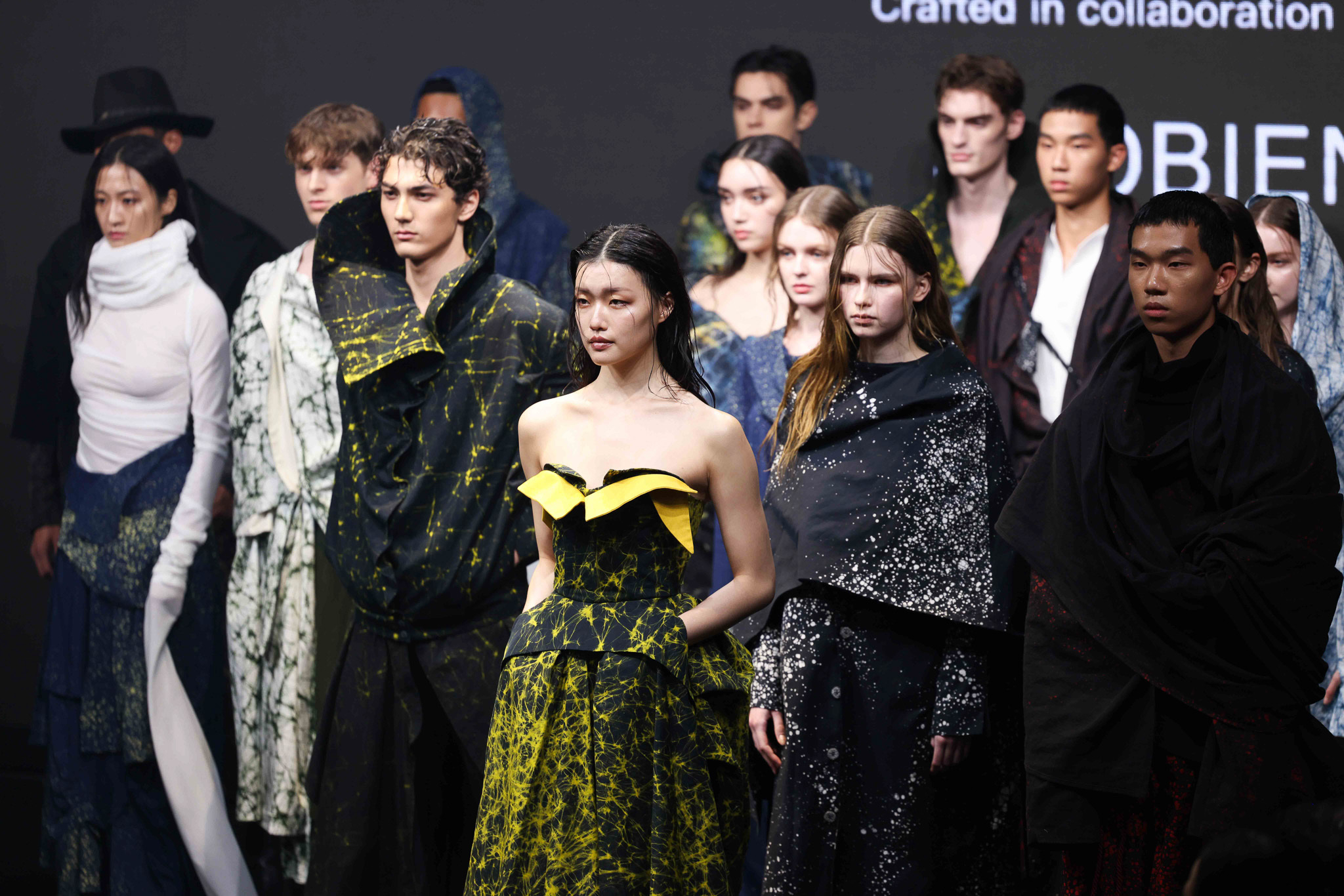
C JEAN presented the SA TA NA MA collection at Taipei Fashion Week AW26, constructing a garment narrative about birth, life, dissolution, and rebirth through cosmic fissures, light-and-shadow textures, and rōketsu dyeing. Photo courtesy of Frank Chen @frankucc.
JEAN, Chun-Yuan further explains that SA TA NA MA originates from a Sanskrit sound meditation, with the four syllables respectively signifying the eternal cycle of birth, life, dissolution, and rebirth. In relation to this collection, she first proposed visual concepts related to the universe, interstellar space, fissures, light and shadow, and the cycle of life. She then repeatedly discussed these ideas with SHOBIEN, using the distinctive characteristics of rōketsu dyeing to bring these abstract themes onto the surface of fabric.
As a result, the distinctive ice-crackle patterns of rōketsu-zome appear across the textile surface with a randomness reminiscent of dried earth or distant nebulae. These textures, formed by the chance interaction of handwork and time, are traces of life that no AI algorithm could replace. The fine cracks created by wax become fissures at the beginning of the universe, while vein-like patterns evoke mountains, rivers, and the force of life spreading outward. The red-black or black-and-white dotted surfaces formed through the rōfubuki technique resemble the lingering warmth of a flame that has not yet fully gone out. Neuron-like motifs, meanwhile, recall the regenerative force that continues to flicker within the vast universe. In this way, textiles are no longer merely materials, but mediums that carry time, memory, and sensory perceptions of existence.
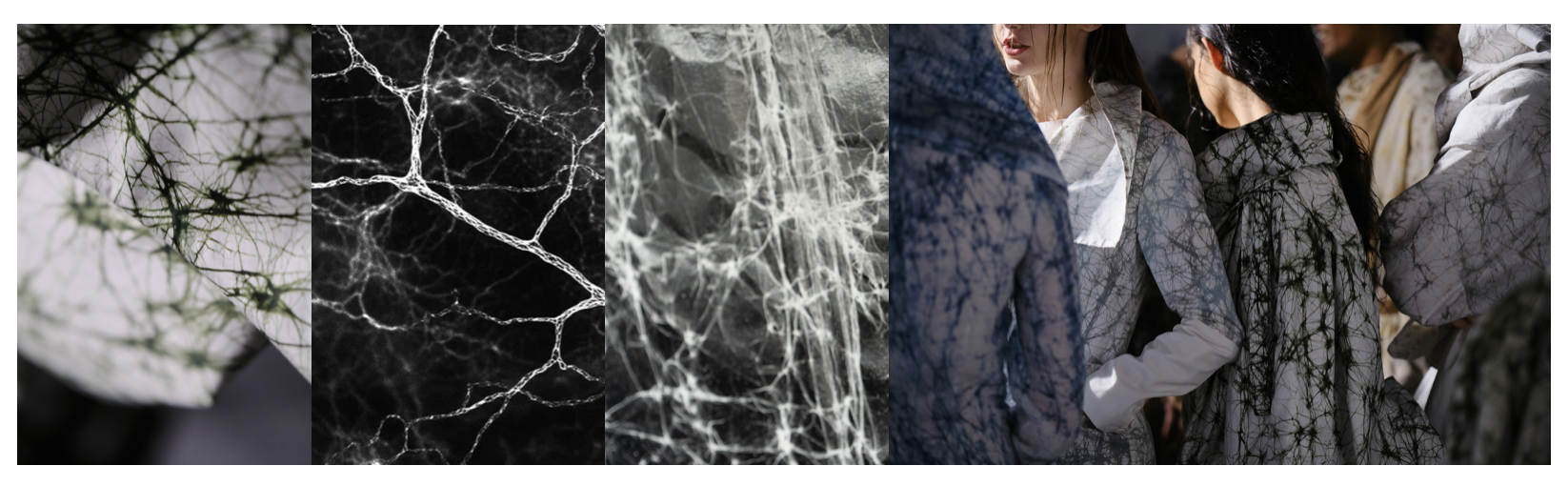 The neuron-like visual concept proposed by JEAN, Chun-Yuan was transformed through rōketsu dyeing into textile patterns, ultimately extending into flowing garment structures on the body and forming the distinctive visual language of the SA TA NA MA collection. Photos courtesy of Shota Inoue @shotainoue, W @windtay, and Gary Lu @yumi__________.
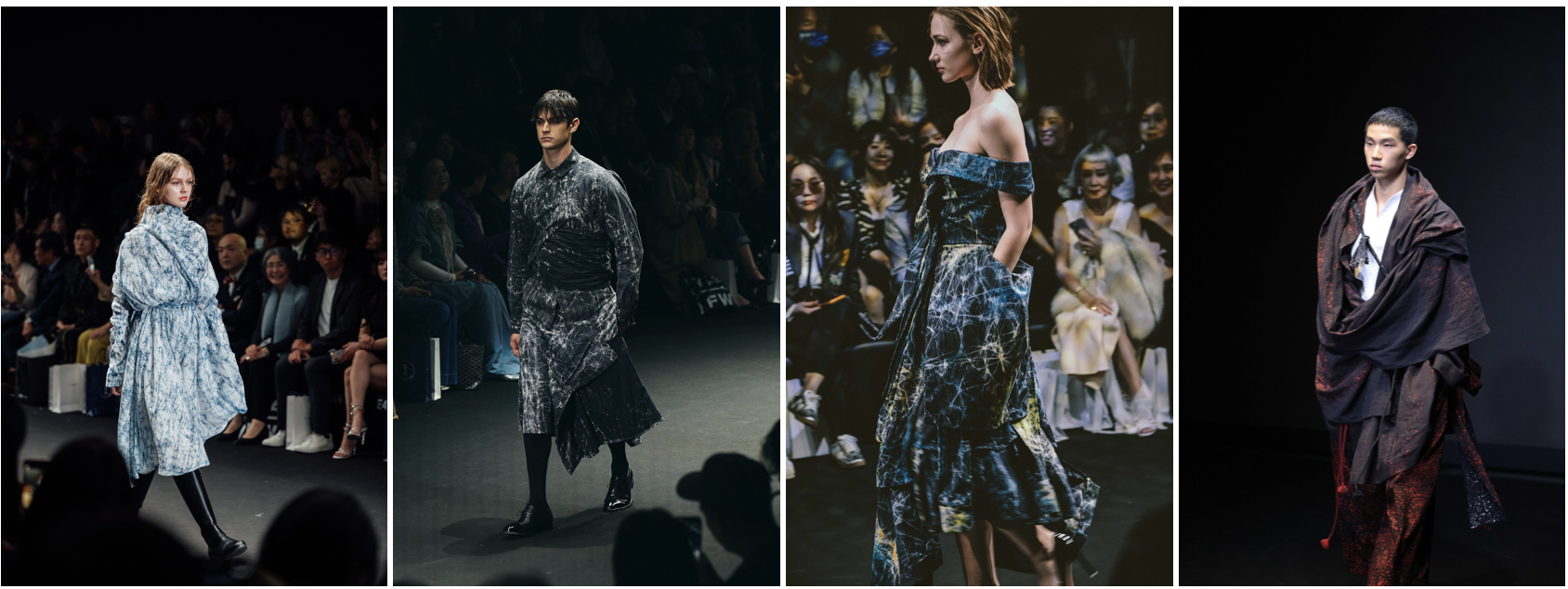
From left to right: SA — blue-and-white rōketsu textures resemble fissures and flowing veins at the beginning of life. Paired with an enveloping high collar and wrapping structure, the look conveys a state that has not yet fully taken shape, but has already begun to gather. / TA — white cracks extending across black-gray fabric like interstellar currents, combined with a wrapped waist and asymmetric skirt panels, symbolize life entering a stage of construction, growth, and operation. / NA — copper-red particles created through the rōfubuki technique evoke the lingering warmth of a flame not yet extinguished; wide draping and layered wrapping structures express a threshold state before dissolution, release, and transformation. / MA — dense light patterns woven across deep blue fabric like a nebula, together with outward-turning lapels and a layered asymmetric skirt, reveal a new order and energy blooming after rebirth. Photos courtesy, from left to right, of Mike @mikesungphoto, Shelmei @shelmei_inc, Frank Chen @frankucc, and Kiki Tsai @kiki.t__.
Beyond Western silhouettes, JEAN, Chun-Yuan also incorporated several loose-fitting designs carrying the imagery of a practitioner’s kasaya robe. On the Taipei Fashion Week runway, she also arranged “Life Walkers” to move among the models. She hoped that the audience would not only look at the garments themselves, but also sense, through the movements and stillness of the wearers, the deeper spiritual structure of the collection, while seeing how rōketsu dyeing could be expanded into more dimensions through this collaboration.
For this reason, what is regenerated through this collaboration is not only the expressive potential of traditional craft within contemporary design, but also a way of looking at the cycle of life. Perhaps viewers may also find echoes of their own SA TA NA MA journey within the work.
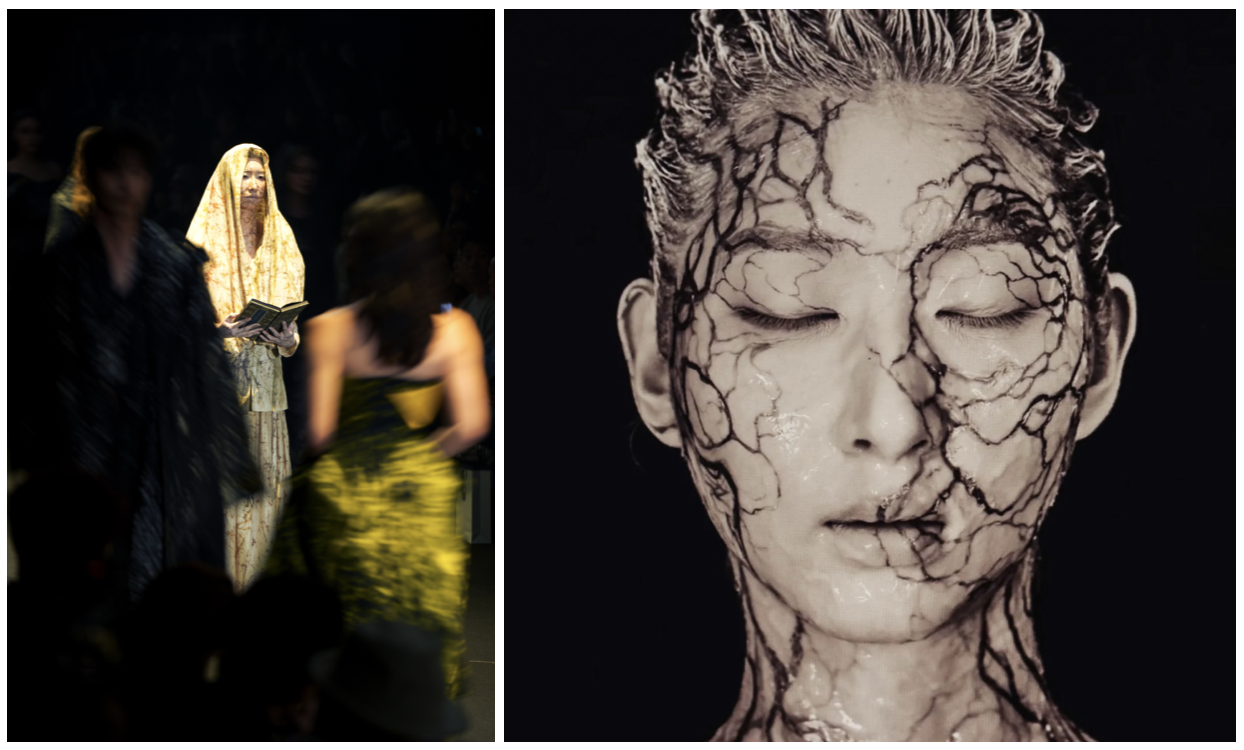
The Life Walkers symbolize the ongoing flow of life, in which healing never stops and the soul slowly returns at its own rhythm. C JEAN also used kintsugi-inspired makeup to trace cracks, transforming brokenness into visible marks and making repair a way for the soul to appear. Photos courtesy of Gary Lu @yumi_____________ and Nico @nicophotogapher.
The Timeless Power of Contemporary Design and Tradition Working Together
For JEAN, Chun-Yuan, creation is the construction of a worldview, not merely the layering of forms. With each collection, she must first convince herself: is this theme truthful enough? Is it worthy of being worn on the body? Can it create a deeper sensory relationship between the garment and the wearer? This creative attitude is also the key reason the collaboration between the two sides could come into being.
For SHOBIEN, this collaboration with C JEAN can be described as a process in which dyeing techniques, family memory, and contemporary design jointly entered the core of creation. In order to achieve the patterns and surface effects proposed by C JEAN, Hiroyuki Kambayashi even reactivated dyeing techniques once taught by his grandfather but long unused, allowing craft memories that had nearly fallen asleep to awaken again within a contemporary creative context.
“Clothing is people’s second skin. When the wearer puts on a garment, I hope they are not merely putting on a piece of fabric, but can also feel the meaning I want to convey. If I can transmit something moving in this way, then I feel that I am not merely making a product.” — Designer JEAN, Chun-Yuan
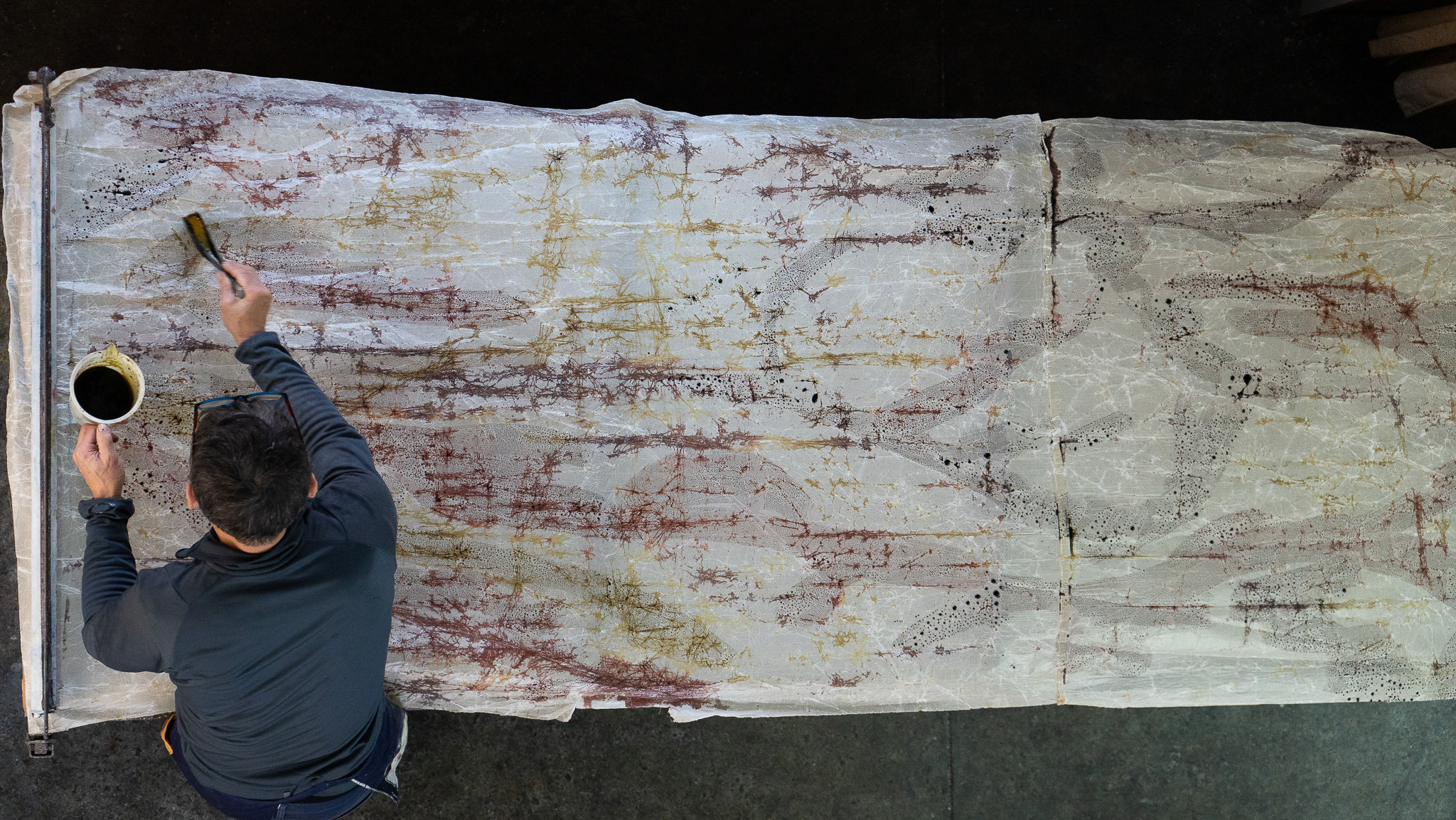 In response to the textile patterns and visual themes proposed by C JEAN, Hiroyuki Kambayashi reactivated certain dyeing techniques that had long been unused within the workshop, allowing craft memory to be awakened once again within a contemporary creative context. Photo courtesy of Shota Inoue @_shotainoue.
Ousuke Kambayashi also frankly shared that he places great importance on this collaboration. He mentioned that a British manager had once discussed with him that although AI is the most talked-about topic of this era, “the next more urgent issue may very likely be business succession.” As more and more small and medium-sized workshops face the reality of having no successors, how to ensure that techniques and knowledge can be truly passed on will become an even more difficult and important issue. For SHOBIEN, this concerns the survival of the craft and is also a responsibility toward the future.
The collaboration between C JEAN and SHOBIEN opens up not only the expressive depth of a single season’s collection, but also a possible path for traditional craftsmanship to enter contemporary haute couture. It proves that the relationship between contemporary design and traditional craft can move beyond the limitations of borrowing and decoration. On the basis of sufficient mutual understanding, the two can jointly create new forms and new ways of seeing.
This creative outcome is now extending beyond the runway into a longer mode of viewing. Following a month-long exhibition held from April 4 to April 26 at iP Gallery in Taipei, during which psychiatrist Dr. Yu Pei-Lin, with her professional background in psychoanalysis, was invited to join JEAN, Chun-Yuan in a conversation related to art therapy, the exhibition titled The Beauty of Imperfection — A Thousand-Year Question will also be presented from May 14 to July 31 at the soon-to-open TSUTAYA BOOKSTORE Songyan store.
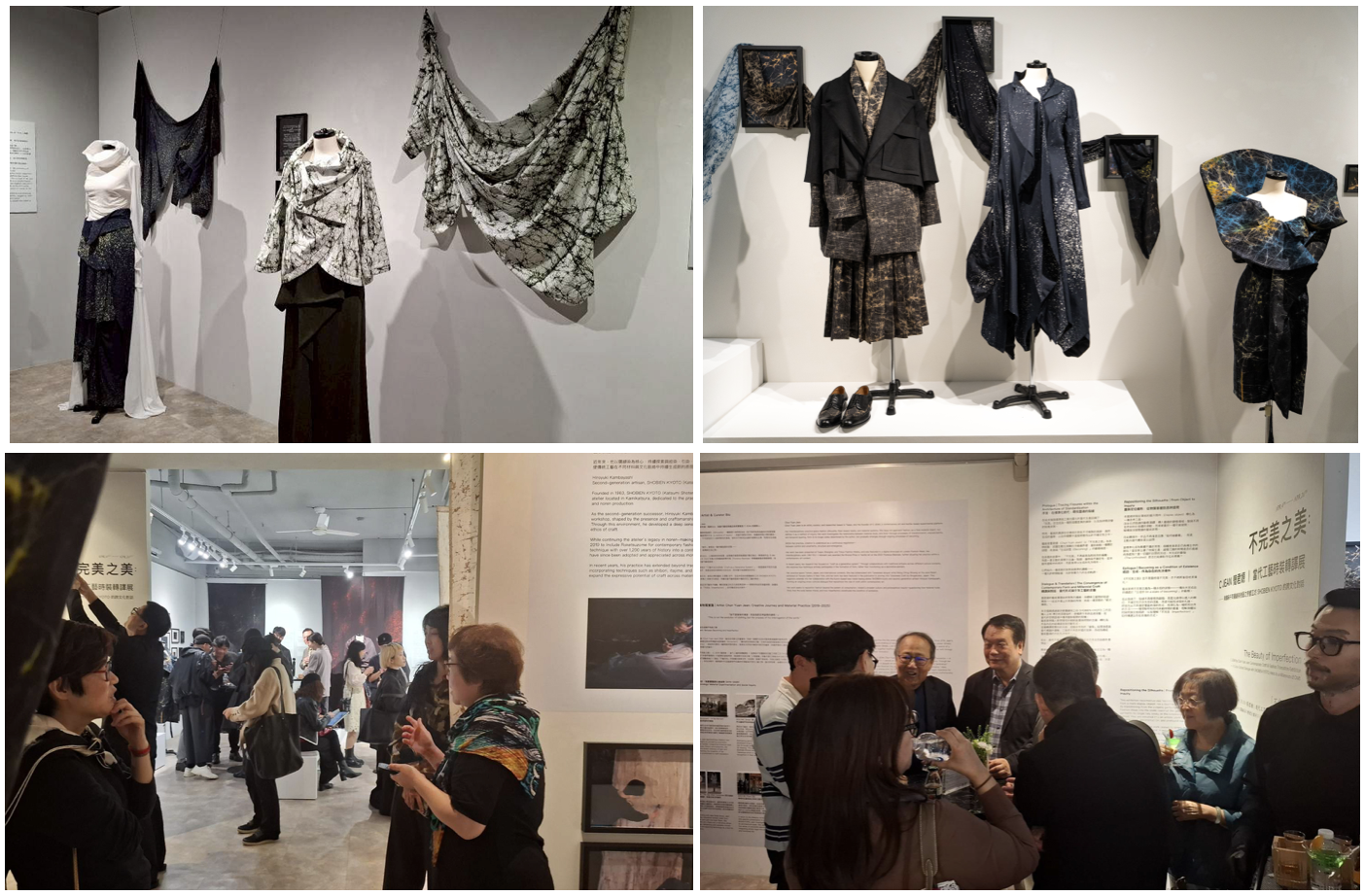
The creative results of the collaboration between C JEAN and SHOBIEN have also been extended into The Beauty of Imperfection exhibition. During the exhibition at iP Gallery, visitors were able to view the works up close and further enter the themes of time, craft, and life proposed by C JEAN through on-site exchange. Photo courtesy of Gary Lu @yumi_____________.
JEAN, Chun-Yuan believes that this kind of post-show exhibition allows viewers to enter the work outside the runway in a slower and quieter way, carefully appreciating the special texture and irreproducible patterns that rōketsu dyeing brings to the fabric, and further experiencing the timeless power that emerges when contemporary design meets traditional craft.
In the future, this creative thread will continue to extend outward, with related exhibition plans moving toward Kyoto and Tokyo, allowing this inquiry into time, the cycle of life, and the translation of craftsmanship to continue fermenting in different cities.
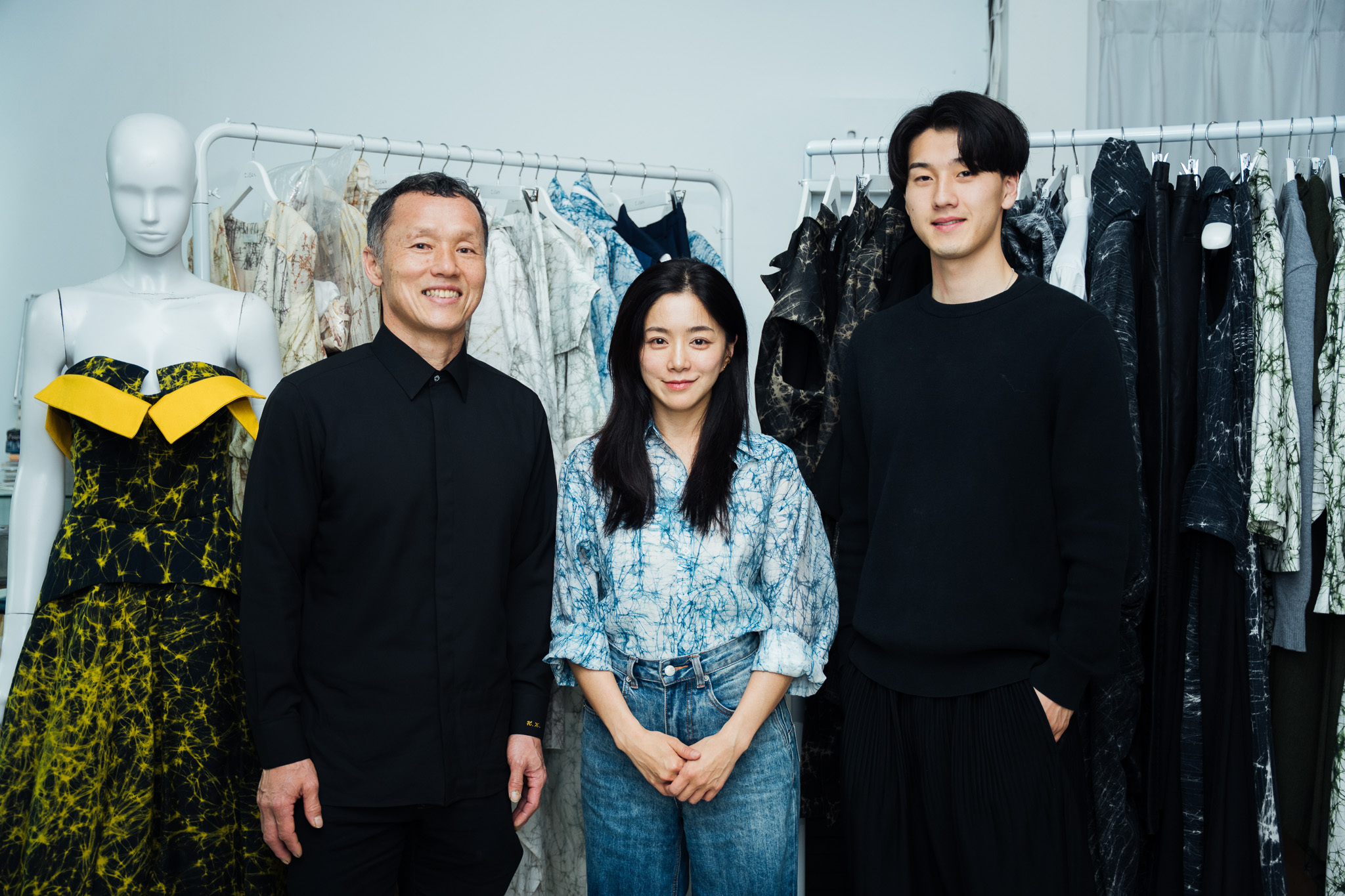
JEAN, Chun-Yuan is pictured with SHOBIEN’s second-generation Hiroyuki Kambayashi and third-generation Ousuke Kambayashi in front of the collection, capturing this collaboration across craft, design, and the theme of time.
▐ Interview & Writing / Xiang Xiang Creative Production Team
▐ Editor & Coordinator / Irene Lin
▐ Interview Photography / Shouya Sung
About the Brand|C JEAN
C JEAN uses clothing and fiber art as mediums to continuously explore the relationships among time, culture, and craftsmanship. The brand is dedicated to translating traditional craft into a contemporary design language, establishing a balance between experimental aesthetics and long-term practice through research-based creation.
For C JEAN, each work is not merely the formation of a silhouette, but a vessel for thought. Clothing responds not only to the body, but also to memory, culture, and lived experience, making dressing a way of perceiving the world.
About the Designer|JEAN, Chun-Yuan
JEAN, Chun-Yuan is the founder, designer, and interdisciplinary creator behind C JEAN. She graduated from the London College of Fashion, University of the Arts London. Her creative practice spans fashion, fiber art, and curatorial work, and she is known for using architectural silhouettes and material research to respond to themes such as time, existence, and cultural inheritance.
In her work, clothing is not simply an external form, but a method of inquiry. Through the intersection of craft and contemporary design, she continues to explore how tradition can be re-understood today and continue to generate new meanings within new contexts.
● Brand Website: https://www.cjean.co/
● Contact: info@cjean.co